en
en
 de
de jp
jp kor
kor fra
fra spa
spa ru
ru pt
pt it
it

MIM Components for Consumer Electronics
Consumer electronics are still shrinking, becoming more compact, and getting more technologically advanced. As more and more detail is added to device designs, manufacturers require metal components that will be strong, accurate, and perform reliably, yet fit into increasingly restricted spaces. MIM Components for Consumer Electronics are a practical solution as Metal Injection Molding can be used to manufacture small and complex metal components in large volumes. Introduce MIM as a process of mixing fine metal powders with a binder, molding, debinding and sintering. The article should begin with a brief introduction on how MIM is supporting smartphones, headphones, charging devices, wearables, connectors, hinges, etc. and small electronic devices.
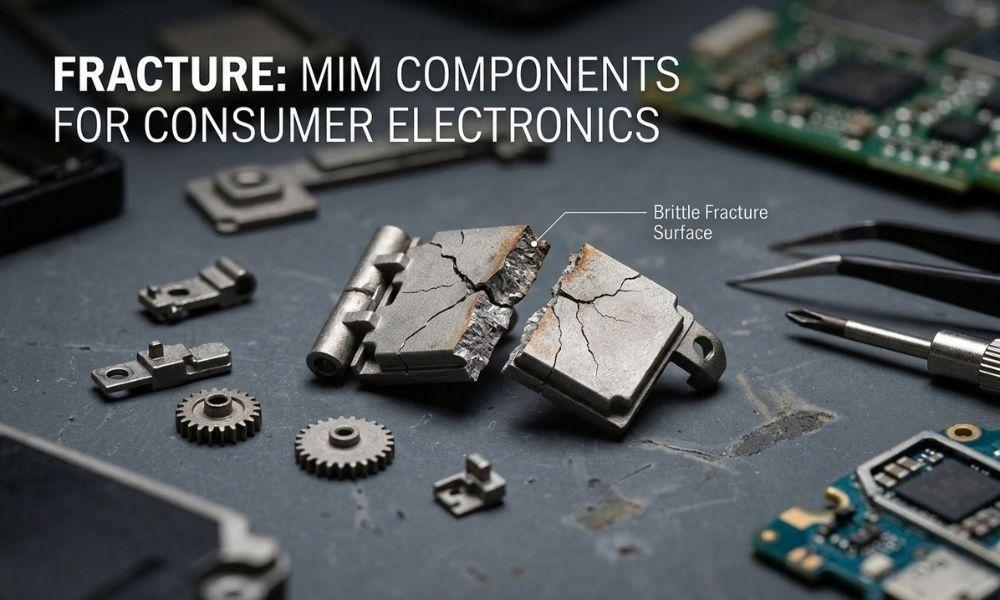
What Are MIM Components for Consumer Electronics?
Metal Injection Molding (MIM) is a relatively new manufacturing technique that is quite different from traditional metalworking processes such as machining and plastic injection molding. The metal powder is very fine and MIM forms a molded shape using a binder which is removed during the sintering process. This enables manufacturers to produce detailed, near net-shape metal components with relatively small amounts of secondary machining required. Discuss the importance of this to electronics where components can be tiny, complex and difficult to
assemble and produce large quantities. According to Harber, MIM is a near-net forming technology that's ideal for complex shapes and high-volume production.
Why Is MIM Useful for Consumer Electronics Manufacturing?
Explain the primary manufacturing problems in the modern electronics industry, such as miniaturization, complex geometry, repeatable dimensions, surface requirements and large production volumes. Describe how the MIM can be used to incorporate multiple design characteristics in a small metal part, and minimize the amount of heavy cutting operation.
Explain how it facilitates multi-cavity molding to achieve higher production rates and its
near-net-shape capability which helps to minimize material waste and secondary processes. Shorten the explanation by demonstrating how each benefit applies to actual electronics manufacturing requirements. Because MIM is well suited to relatively small, more complex parts, and can be produced at high rates with multi-cavity molds, it is a very popular method for producing such components, says Harber.
Common Applications of MIM Components in Consumer Electronics
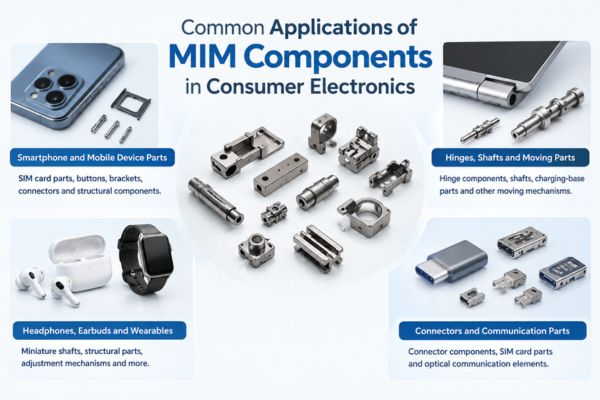
Smartphone and Mobile Device Parts
Explain how MIM can be used for small metal components found in smartphones and related accessories. Cover examples such as SIM card parts, buttons, brackets, structural components, connector-related parts, and other small mechanical components. Focus on why these parts need accurate dimensions and consistent production so they can fit correctly into compact assemblies. Mention that Harber lists consumer electronics parts and electronic components among its MIM applications and provides customized components for different designs.
Hinges, Shafts, and Moving Parts
Discuss MIM applications involving small moving components, such as hinge parts, shafts, rotating components, and charging-base components. Explain why these parts need controlled dimensions, strength, wear resistance, and reliable movement. This section can also mention applications in foldable devices, laptops, charging accessories, and other products with moving mechanisms. Harber's consumer electronics product information specifically includes
charging-base shaft and hinge parts and describes customized MIM production.
Headphones, Earbuds, and Wearable Devices
Describe the role of small MIM components in headphones, earbuds, smartwatches etc. (wearable electronics) Talk about smaller pieces of metal that make up the parts, e.g., adjustment mechanism, miniature shafts, structural parts, etc. Emphasize compactness, durability, beauty and repeatability for these products. Be sure to keep this portion of the section focused on the practical aspects and not go into a laundry list of individual elements.
Key Benefits of MIM Components for Consumer Electronics
Explain the major advantages manufacturers can gain from MIM. Cover complex shapes, dimensional consistency, high-volume production, material efficiency, good surface quality, reduced secondary machining, and design flexibility. Explain that MIM can produce parts close to their final shape, which may reduce additional processing. Also mention that Harber reports high sintered density, multiple material options, and minimal secondary machining as key MIM benefits.
Materials Used for MIM Electronics Components
Explain the relationship between the function and properties of a component and the selection of materials for it. Covers standard materials like stainless steels, low alloy steels, titanium alloys, soft magnetic alloys and tungsten alloys. Discuss how stainless steel may be beneficial in consumer electronics applications when strength, corrosion resistance, durability and appearance are all important. Include examples like 304L, 316L and 17-4 PH in Harber's published range of MIM materials.
How Are MIM Components Manufactured?
Explain the manufacturing process in a clear sequence:
1. Geometry, Function, Tolerances, Material and Volume: Examine the geometry, function, tolerances, material and expected volume of the component.
2. Mold design and manufacturing: Make up the tools capable of making the mold with the same shape repeatedly.
3. Preparation of feedstocks: Mixing fine metal powder with an appropriate binder system.
4. Injection molding: Feed the material into the mould and produce the first part.
5. Debinding: Controlled thermal or solvent processes to remove most of the binder.
6. Sintering: Apply heat to the molded part in a controlled way to burn away the binder and make the metal particles more compact.
7. Finishing and inspection: Carry out necessary finishing operations and measure dimensions, look and other quality specifications.
Discuss that it is essential to take care in controlling the component because it will shrink while being sintered. Harber says control is important in order to achieve dimensional repeatability and consistent quality from mold design and raw-material blending up to the sintering stage.
Design Considerations for MIM Electronics Parts
Discuss the considerations which should be taken by the engineers before selecting MIM. Specify part size, thickness, intricate features, holes, draft, tolerances, anticipated shrinkage, material selection, surface finish, and production quantity. Tell your students that MIM is ideal for
small and complex components, but not for large or very simple components. Have designers speak with the MIM manufacturer early in the design process to ensure the final dimensions and production cost are not impacted by the characteristics of the tools used or the behavior of the sintering. Harber's published comparison indicates that MIM has high complexity capability and production volume for high volume applications.
MIM vs. Other Manufacturing Methods
Discuss the comparative merits and demerits of MIM, CNC machining, conventional powder metallurgy and investment casting. Describe that CNC machining may be useful for prototypes and low volume production of components, but for more complex components more material may need to be removed to create the part. While certain simple parts and volumes can be successfully produced using conventional powder metallurgy, complex features may have more restrictions. Investment casting can be used for complex metal parts, but it may not be as beneficial for very small and complex parts. Ensure that the best process is determined by geometry, material, volume, tolerances, and cost. The published comparison by Harber reveals differences in complexity, surface finish, volume of production, range of materials among these processes.
Quality Control for Consumer Electronics MIM Parts
Describe the importance of quality control in the manufacture of components that have to be fitted into very exacting electronic assemblies. Dimensional inspection, material inspection, surface inspection, hardness/mechanical testing as necessary, and final inspection before shipment. Indicate that "100% inspection prior to shipment", as well as "hardness, tensile, 3D projection inspection", are noted by Harber.
How to Choose a MIM Manufacturer
Describe the considerations that buyers need to consider when choosing a supplier. Include MIM experience, capability of the tools, expertise with materials, production capacity, quality-control processes, finishing processes, prototype support, lead time, and
communication. The buyer should also inquire if the manufacturer is able to provide support in the design and tooling, molding, debinding, sintering, finishing and inspection of the project. It can be used at various stages of the MIM development, it can be used in consumer electronics, and other industries, says Harber.
The Future of MIM in Consumer Electronics
Highlight that the ongoing miniaturization of products and growing details of mechanical structures can provide opportunities for MIM. Define the need for manufacturing processes to be able to produce small, strong and accurate components in large quantities. MIM is beneficial in cases where the component is complex in shape, has an exacting material specification, and is
required in multiple quantities. Ensure that any prediction made is supported and concentrate on manufacturing attributes which make MIM relevant for evolving electronics designs.
FAQ:
What are MIM components for consumer electronics?
MIM components are tiny metal components produced by the process of Metal Injection Molding. The process is advantageous for manufacturing intricate and accurate parts for smartphones, headphones, wearables, connectors, hinges, and other electronic devices.
Why MIM is apposite for the manufacture of consumer electronics?
MIM is appropriate as it can manufacture small pieces of metal with intricate designs and dimensions that are consistent and have good surface finish. It is also suitable to high volume production because it is practical for electronic products with high production volume.
What are the materials used in MIM electronics components?
Common MIM materials include stainless steel, low alloy steel, titanium alloys, soft magnetic alloys and tungsten alloys. The choice of material will be determined by the properties required for the component, its corrosion resistance, wear resistance, size, and use.
Conclusion
Explain about the capabilities of MIM components for consumer electronics manufacturing of small complex, durable and repeatable metal parts. Briefly recap the major applications, materials, manufacturing steps, design considerations, and quality requirements covered in the article. Finally, reiterate that MIM should be the component's geometry, material, production volume, tolerance, performance requirements, and overall manufacturing cost that determine the choice of MIM, not just choosing it for every application in electronics.