en
en
 de
de jp
jp kor
kor fra
fra spa
spa ru
ru pt
pt it
it

Precision Metal Injection Molding Medical Devices
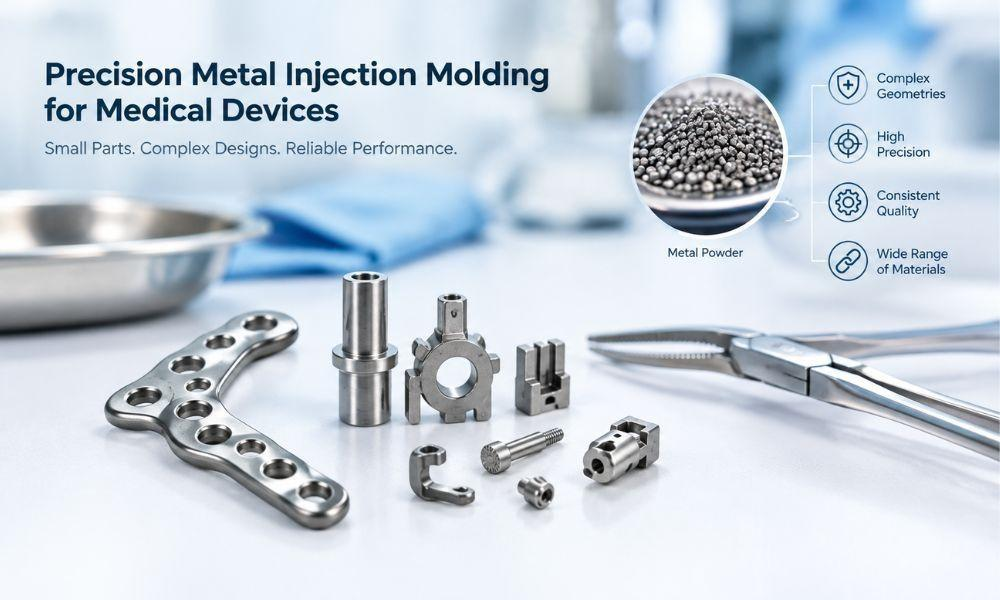
Complex and difficult-to-manufacture small metal parts and parts with precise dimensions and performance are often needed in medical devices. In some instances, manufacturing a complicated part using traditional techniques may be difficult or costly, or creating a large quantity of parts using traditional methods can become impractical. Precision Metal Injection Molding Medical Devices is a manufacturing method that combines metal powder technology and injection molding to make the formation of detailed components. This article will discuss how it works, materials used, medical applications, benefits, design considerations, and quality requirements. It will also enable manufacturers to get an insight into when MIM can be considered for their projects.
What Is Precision Metal Injection Molding for Medical Devices?
Precision metal injection molding is an injection molding process that combines powder metallurgy and molding techniques to manufacture small and complex metal parts. A feedstock is made of fine metal powder and a binder which is used to shape the powder inside a mould. The binder is removed and the part is sintered to produce the final metal structure. It is a technique that works for certain medical parts that demand fine detail, repetition and appropriate material properties. Discuss difference between General MIM and medical component
manufacturing, as in both cases there is a need for matching properties of the material, cleanliness and quality requirements of the product with the application.
How Does the Metal Injection Molding Process Work?
The MIM process consists of a number of important steps whereby the metal powder is transformed into a final product. First manufacturers make a uniform feedstock with fine metal powder and binder. The material is then forced into a mold to form the shape required. The binder is removed from the part by a process called debinding and the part is heated during the sintering process, which creates a stronger structure of the metal particles. The part can then be finished, cut or inspected. Describe the impact of each stage on part quality, dimensional accuracy and repeatability and the importance of process control in medical manufacturing.
Feedstock Preparation and Injection Molding
Explain the preparation of metal powder and the role of binder in metal molding and why it is necessary to have a uniform metal for molding. Explain the process of precision molding small features and shapes from the feedstock that is fed into a precision mold. In a simple way explain “green part” and that the molded part must be processed further before it reaches its final state.
Debinding, Sintering, and Finishing
Explain Debinding process and Sintering Process. Discuss shrinkage during sintering and the need to consider shrinkage in the design of molds and parts. Discuss the finishing processes that can be applied to the component, including machining, polishing, heat treatment and dimensional inspection.
Benefits of Precision Metal Injection Molding for Medical Devices
Precision Metal Injection Molding Medical Devices can provide some advantages to manufacturers with small and intricate metal components. High complexity shape is produced through the process, which might be difficult to make by conventional machining method. It can also offer repeatable production for appropriate quantities and can help to minimize material waste in certain applications. Stronger alloys or alloys that resist corrosion or exhibit other desirable properties might be used. But not all parts are necessarily best suited to MIM, and it is not necessarily the cheapest method. Discuss the importance of geometry, production volume, tooling costs, tolerances and how these are used to determine the final choice.
● Works with small and complex component designs.
● Produces repeatable parts for appropriate part volumes.
● May be able to save material costs compared to other machining processes.
● Offers options for the choice of appropriate metal alloys.
● May be able to decrease per-part cost at higher production volumes.
● Assists manufacturers in creating exact and uniform parts.
● Needs correct design and control of process to get consistent results.
Materials Used in Medical Metal Injection Molding
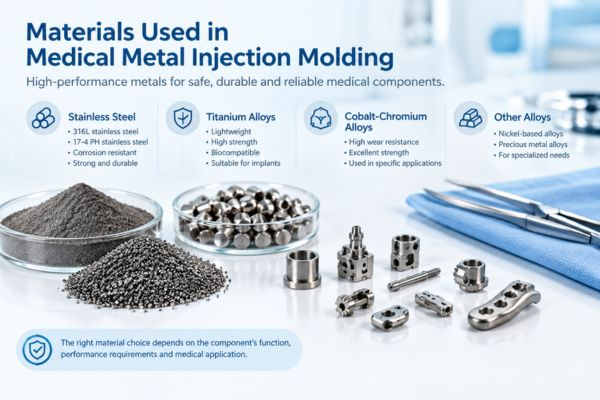
The choice of materials is one of the factors that can affect the medical component manufacturing process, as the metal needs to match the requirements of the specific application. Due to its strength and corrosion resistance, stainless steel is discussed in much depth for surgical tools and other medical parts. The titanium alloys can be used for some implants and light applications, and the cobalt-chromium alloys can be used for a certain mechanical and medical requirement. Describe the differences between these materials, and why engineers need to take into account strength, corrosion resistance, biocompatibility, purity and manufacturing performance. The final material shall always be chosen according to the application and requirements for the device.
Common Metal Materials
● Selected 316L and 17-4 PH stainless steel.
● Titanium and titanium alloys for suitable medical applications.
● Selected component requirements (Cobalt-Chromium Alloys).
● Other metals which can be suitable for certain medical applications.
Discuss that not all alloys will work for all medical devices. When choosing suppliers, it is important to take into account material certification and traceability.
Medical Devices Made with Metal Injection Molding
Metal injection molding has been utilized for various medical production processes, particularly within the realm of small size, complicated geometry and repeatability. Small parts, such as small jaws, graspers, and other complex parts of surgical instruments. When appropriate, selected orthopedic and implant related components can also be benefitted with MIM. Other areas to talk about are dental components, medical instrument mechanisms and diagnostic equipment parts. Explain that the appropriateness of MIM will vary based on the component's function, material, tolerances, and applicable medical requirements.
● Surgical instrument components.
● Miniaturised surgical instruments and parts.
● The selection of orthopedic and implant related components.
● Any dental and orthodontic parts.
● Diagnostic equipment components.
● Medical instruments with small mechanical components.
● The selected components for the robotic-assisted surgical system.
Design Considerations for Medical MIM Components
The accurate and reliable production of MIM components is achieved with the aid of good design planning. Before production, engineers need to take part geometry, wall thickness,
feedstock flow, and mold designs into account. The shrinkage that occurs during sintering is to be considered in designing the mold. Critical tolerances should be determined at an early stage in project, including any requirement for secondary operations like surface finishes. The material used should also be suitable for the function and performance of the component. Describe the benefits of DFM support in reducing production problems and determining if MIM is a suitable manufacturing process for a part.
● Select an appropriate shape to be produced by injection molding.
● Take into account wall thickness and feedstock flow.
● Take shrinkage into account when sintering.
● Explain what critical dimensions and tolerances are.
● Carefully plan out the mold design.
● Choose the appropriate metal alloy.
● Determine finishing and secondary machining requirements.
● Check the design prior to production.
Quality Control in Medical Metal Injection Molding
This is why it's important that components for medical devices are manufactured with quality control in mind. It is imperative for manufacturers to monitor raw materials, feedstock preparation, molding, debinding and sintering to get consistent results. A dimensional inspection can be used to ensure that the finished parts are within the specified tolerances and material records ensure the parts can be traced back to the materials. In addition, the performance requirements and cleanliness and surface finish may be required as appropriate to the application. Describe the purpose of documented procedures, process validation, inspection and change control. Although ISO 13485 is a Quality Management System standard for medical devices, use of the standard in certification or compliance statements are only valid when there is confirmation for the specific supplier.
● Use of raw material quality and consistency checks.
● Keep track of key manufacturing processes.
● Check dimensions and critical tolerances.
● Inspect surface finish and cleanliness as necessary.
● Keep materials traceability and production records.
● Review relevant medical device quality requirements.
● Verify completed components to the customer's requirements.
Precision Metal Injection Molding vs. Traditional Manufacturing
There are various manufacturing approaches providing various advantages for medical parts. MIM can be used for small, complex components and for repeat production of components at suitable quantity. CNC machining could work for prototypes, low volume production or to machine parts from solid metal. It may also be suitable to invest cast a few complex shapes.
Analyze the differences between these methods with respect to part geometry, tooling, production volume, material waste, tolerances, and part finish. Discuss the fact that there are no standard methods for each medical component, and what is best will depend on the design and manufacturing objectives.
Factor | MIM | CNC Machining | Investment Casting |
Complex small parts | Suitable for many intricate shapes | Depends on geometry | Suitable for selected complex shapes |
Production volume | Often suited to higher volumes | Useful for prototypes and lower volumes | Depends on the part |
Tooling | Requires mold investment | No injection mold | Requires casting tooling |
Material waste | Can reduce waste for suitable designs | Depends on machining process | Depends on casting design |
Secondary operations | May be needed | Depends on the part | May be needed |
How to Choose the Right Medical MIM Manufacturer
Choosing a suitable manufacturing partner is an important step for medical device companies. The first thing to do is determine if the supplier has previous experience in metal injection molding and the right type of metal. Check its engineering assistance, tooling, manufacturing and test facilities. Inquire into the company's approach to material tracking, quality documentation, tolerances, and finishing specifications. It helps to establish production volumes, lead times and communication prior to a project. A thorough supplier review can help the manufacturer determine if the supplier is equipped to meet its component needs.
● Review experience in metal injection molding.
● Discuss appropriate metals and alloys.
● Review tooling and Design support.
● Verify quality checking skills.
● Inquire about production capacity and lead times.
● Verify material traceability/documentation.
● Discuss tolerances and finishing requirements.
● Resesscow Communication & Project Support.
Why Choose Harber MIM for Medical Component Manufacturing?
In this section, you should introduce Harber MIM as a company related to the topic of the article. Provide accurate details from the official web page about their metal injection molding services, materials, engineering assistance, and manufacturing skills. If the company provides medical component manufacturing, outline the services in an accurate manner based on information provided in its profile. Don't make unfounded claims regarding certifications, medical industry experience, tolerances or volumes produced. The section should include some way to reach the company to talk about a component design, material requirement, or a production project.
FAQ:
Medical components gain from what benefits of MIM?
Refer to any complex shapes, any repeatability, any material flexibility, and possible cost benefits of production at appropriate volumes.
Can MIM be used for small and complex medical parts?
Discuss that MIM may be used when the geometry is small and complex, material restrictions apply, tolerances are tight and/or production volume is low.
How does a medical device manufacturer begin a medical device MIM project?
Outline the initial steps: Exchange part drawing or CAD, discuss material and quantity, discuss manufacturability, confirm quality requirements with a qualified supplier.
Conclusion
The Precision Metal Injection Molding Medical Devices are capable of producing small, complex metal parts for specific medical applications. The injection molding and powder metallurgy techniques that it combines provide it with design flexibility and repeatability for production if the part requirements are appropriate. The result is achieved by considering many factors such as material selection, design of the mold, control of the sintering process and quality inspection.
Manufacturers need to evaluate MIM and other techniques and need to collaborate with a credible supplier to start manufacturing activities. MIM can be a helpful method for creating dependable medical device components provided planning and process control is correct.