en
en
 de
de jp
jp kor
kor fra
fra spa
spa ru
ru pt
pt it
it

MIM vs CNC Machining for Industrial Metal Parts
Begin by describing that in industry, manufacturers frequently have to select a production process which considers accuracy, complexity, volume, materials and cost. MIM vs CNC
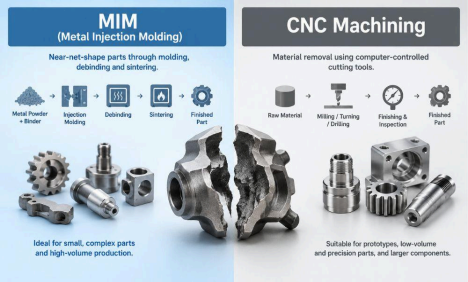
Machining is an important comparison to be made as both processes are capable of creating precision metal parts; but they do so in completely different manners. In Metal Injection Molding, the metal powder and binder are used to produce parts that are near the final shape followed by debinding and sintering, whereas in CNC machining, material is removed from a solid to achieve the desired shape. Describe that there is no universal process that applies to all parts. Before deciding on a manufacturing process, part size, part geometry, annual production volume, material, tolerances, surface finish, investment in tooling, and stability of the part design should all be taken into account.
What Is Metal Injection Molding (MIM)?
Explain in simple words about what Metal Injection Molding is and how it combines the metal powder technology with injection molding. Feedstock, a blend of fine metal powder and a binder is fed into a mold to form a green part. During debinding the binder is removed and the part is sintered in a controlled furnace to achieve the required properties and dimension. Explain why this process is useful for producing small, complex metal components that would need multiple machining operations were it to be made from solid material. Supported repeat production: MIM
can be used for small ribs, grooves, holes, curves and other intricate shapes. It is claimed that MIM is suitable for complex parts and high volume production, and provides materials like stainless steels, low alloy steels, tool steels, titanium, tungsten alloys, and other material families.

What Is CNC Machining?
Describe CNC machining as a subtractive manufacturing process using computer controlled cutting tools that remove material from a block of metal. Add general manufacturing processes like milling, turning, drilling, boring and other precision manufacturing techniques. Describe how CNC can make accurate holes, threads, flat surfaces, slots and other detail features from materials like steel, stainless steel, aluminum, titanium, brass and other machinable metals. It is particularly effective for production runs that are small, prototypes which require production or a design in flux where the manufacturer can change the machine directions without the need for a special injection mold. Also describe that the longer a part is to be machined, the more complex the geometry, difficult tool access, multiple setups and the amount of material to be removed, the greater the time will be.
MIM vs CNC Machining
Factor | MIM | CNC Machining |
Manufacturing method - | Near-net-shape molding | Subtractive machining |
Best suited for - | Small, complex parts | Prototypes, low-volume and precision parts |
Tooling - | Dedicated mold required | Usually no dedicated production mold |
Production volume - | Medium to high | Low to medium |
Complex geometry - | Very strong | Depends on tool access and setups |
Large parts - | More limited | Well suited |
Design changes - | More expensive after tooling | Easier to accommodate |
Material waste - | Generally lower for suitable geometries | Can be higher |
Upfront investment - | Higher | Lower |
Recurring machining cost - | Potentially lower for suitable high-volume parts | Increases with machining time |
Secondary machining - | Sometimes required | Often part of the main |
process |
Production Volume and Tooling
Describe how the volume of production could have a significant effect on the choice of the process. The starting cost can be high since MIM demands for moulding and tooling before actual production. Once the mold is ready, however, large quantities of molding can be accomplished in multiple cavities and repeatable molding cycles. CNC machining does not require a special MIM mold and can be suitable for prototyping, sampling, small batch and frequently changing products. Explain the need to look beyond cost of the tooling to consider the entire production lifecycle when deciding on a tooling. The cost structure for a stable production project can have a significantly different form compared to a short-run project. The description by Harber states that MIM would be appropriate for the production of large numbers of complex parts, and multi-cavity tooling was used to help with the production.
Part Complexity and Size
Discuss how part geometry influences relationship between these two processes. MIM is ideal for relatively small, complex 3D components, since a great deal can be molded. This can decrease the amount of single operations of machining and assembly. More complex parts can also be produced by CNC machining, if highly complex geometry is involved, then several changes of cutting tools, work holding, machine setup or machine configuration may be necessary. Meanwhile, it can be more practical for bigger parts that are beyond the usual size range of MIM because of CNC. Discuss that wall thickness, draft, mold filling, shrinkage and sintering behavior are still important in the design of MIM.
Material Selection for Industrial Metal Parts
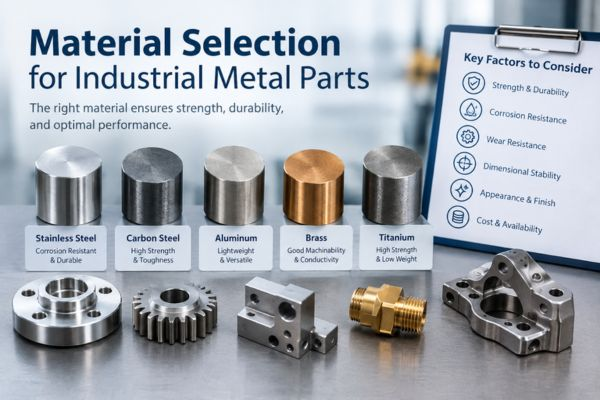
Make comparisons of material consideration for both manufacturing processes. CNC machining is capable of using a wide variety of material that is commercially available and this flexibility is desired by manufacturers when they need to use a specific billet, bar, plate or other stock shape. In addition, several other material families can be supported by MIM such as stainless steel, low alloy steel, tool steel, titanium, tungsten alloys, and so forth suitable powdered materials. Describe the importance of selecting materials based on the properties required of a component and not on the method used to manufacture the material. Other materials that Harber says the company can do MIM include 304L, 316L, 17-4 PH, titanium alloys, tungsten alloys and low-alloy steels.
Tolerance, Precision, and Surface Finish
Explain that both manufacturing processes can make precision components, but in different ways that create precision. CNC is capable of cutting the final geometry directly from the
workpiece and is suitable for critical holes, threads, flatness, sealing applications, etc., where the dimensions have to be controlled. Because of the dimensional changes that occur during debinding and sintering, it is important to take into account the following factors when designing the mold: feedstock consistency; process control; and sintering conditions. Describe the secondary CNC machining that can be performed on selected MIM configurations in the event the tighter specifications are required. Depending on the application, the surface finishing can be treated by polishing, grinding, plating, coating, blasting etc. Harber also provides product examples of MIM tolerances and secondary CNC capabilities for tighter tolerances.
Cost and Material Efficiency
Point out that the production cost should be considered as "total cost" and not just the quoted price per unit. For MIM, the calculation can be for mold development, feedstock, molding, debinding, sintering, inspection and finishing. There are several factors that will contribute to CNC cost, such as raw material, CNC Programming, Machine Time, Cutting Tools, Time of Work HOLDING, Finishing, and Inspection. Differentiate the two technologies: CNC can remove material from a larger stock piece, while MIM is used to create a near-net-shape component and may save material that would otherwise be removed. One of the benefits of its MIM process, Harber says, is saving in material waste and in machining processes.
Lead Time and Production Flexibility
Explain the difference between development time and production flexibility for the two processes. CNC can be used to quickly turn around a prototype from a CAD design, which is helpful for engineers trying out and tweaking a design before they have specific MIM tooling. Prior to stable mass production, MIM needs to define the mold, produce the mold, evaluate the samples, debind the samples, sinter them, and validate the production process. The tooling and process, however, can be developed and utilized efficiently for repeat production in MIM. Note that design stability is also important: If a product is in a state of constant change, it might be worth considering that the product could be tried in machining; however, if the design is one that is well established and a large number of units are required, it may be better to consider MIM tooling.
When Should You Choose MIM?
Write situations in which MIM can be a practical manufacturing process. Pay attention to small, intricate pieces of metal that are likely to be manufactured in medium or large volume. Point out parts that have complex shapes, geometry, multiple integrated components, thin sections and multiple parts that could be machined in several processes. Talk about automotive, electronics, medical devices, industrial machinery, hardware, locks, watches and other precision applications. Harber lists automotive, electronics, medical, machinery and hardware among the applications.
When Should You Choose CNC Machining?
Describe when CNC machining may be helpful for prototypes, development samples, lower volume production runs, larger parts, and designs that are evolving. It can also be appropriate when a part has features that must be worked with high tolerances or when the desired material is more readily available in solid stock. Discuss the fact that CNC is not always competing with MIM in each project. Rather it can be used alongside MIM, where only certain features are to be precision machined. This provides an additional flexibility and dimensionality trade-off option for manufacturers.
Can MIM and CNC Machining Work Together?
Explain that manufacturers have the option of using both processes—rather than choosing one or the other—as separate options. MIM can be done to the main component so close to its final shape that the remaining holes, threads, critical surfaces or dimensions can be CNC cut after that. This could be a way to not have to machine the entire part from a solid block, but to still meet the tighter requirements where desired. Harber mentions the use of CNC machining, which is relevant to production of industrial components, where tighter tolerances and specification requirements are needed.
How to Decide Between MIM and CNC Machining
Describe a real-life decisionmaking procedure that engineers should follow. Check the size and geometry of the part first. Then, calculate the expected annual yield and if the design is stable. And consider material requirements, critical tolerances, surface finish, production lead time, tooling budget and secondary operations. Determine the overall manufacturing cost, not just the price of the tooling or the cost of the unit. If the part is a complicated industrial component, suggest discussing with an experienced manufacturer, the 2D drawing, 3D CAD model, material specification, annual quantity, critical dimensions and application requirements prior to finalizing the process. It can inspect drawings and samples, and offers MIM, CNC, tooling, finishing and testing services, writes Harber.
FAQ:
What is a MIM Consumer Electronics?
MIM components are small, precision metal parts made using Metal Injection Molding. They can be used in consumer electronics, as it's possible to create complex shapes, accurate dimensions, and consistent parts in high volumes.
Why do consumer electronics companies use MIM?
The advantages of MIM to electronics are its ability to fabricate small and complex metal parts and its high repeatability. It will also minimize secondary machining and facilitate high volume production.
Do you need to compare MIM vs CNC machining for electronics components?
They are not always better, or worse, than the other. While MIM is ideal for smaller, more complex parts that are required in high volumes, CNC machining can be more appropriate for prototypes or lower volume manufacturing or for parts that are highly customized. The best choice is related to part geometry, volume, tolerances, material and cost.
Conclusion
Nearby emphasizing that MIM vs CNC Machining should be looked upon based on the specific requirements of an industrial metal component in actual practice. MIM is a good choice for small, complex components that require repeat production and efficient near-net-shape forming, whereas CNC machining is flexible in terms of prototype and low-volume production, larger components, and parts that need direct-cutting. The decision should be based on geometry, material, volume, tolerances, surface finish, tooling, lead time and total cost. The CAD model and production requirements can be used to identify the most suitable manufacturing method for a particular component, be it MIM or CNC or a combination of both.