en
 de
 jp
 kor
 fra
 spa
 ru
 pt
 it
China MIM Guide: Tolerances, Tooling Costs, Risks (2026)
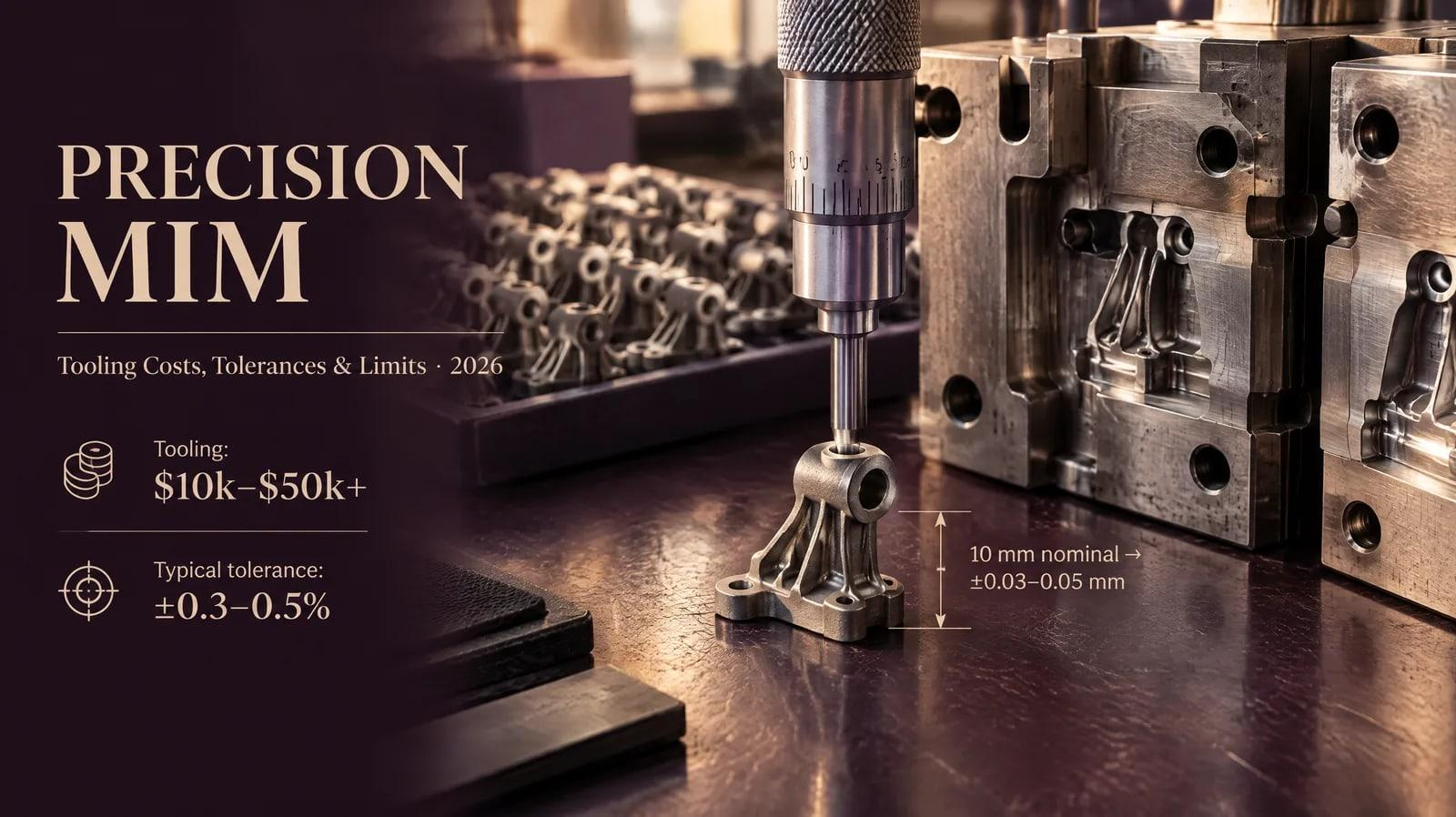
China MIM is the metal injection molding process done by Chinese suppliers. Similar to other MIM processes, the starting materials are fine metal powder and a binder which after molding are debound and then sintered to create the final part. In contrast to China MIM, other lower tolerances are ±0.3-0.5% (depending on the dimension) of the final part. Considering freight and tariffs, the total cost of producing the part in China may not be lower compared to producing the part in the US (Harber-MIM, 2026).
You’re likely already aware that MIM can be an more economical option than CNC machining, especially for small and complex parts. However, there are many factors that suppliers fail to mention on their pages. In this guide we will cover those, i.e. the absolute tolerances of your part at various sizes, the breakeven volume, and circumstances where it may not be cheaper to produce the part in China.
Key Takeaways
● China MIM is the metal injection molding process carried out in China. This process involves molding of metal parts with binders and then removing the binders (debinding) to just metal parts which are then sintered. Some of the key stages in this process include compounding (of metal powders with binders and other additives), molding (of the compounded material) and sintering of the parts.
● MIM tolerances are usually between +/- 0.3-0.5% of the given dimension, so if a tighter tolerance is required the feature would need to be post machined [Precision-MIM, 2026] (Harber-MIM, 2026).
● Tooling quotes from China are commonly reported to be 30-60% lower compared to quotes from the US, however we often do not have enough information to fully understand the complexity of the each case scenario (i.e. ZetarMold, 2026).
● The final cost (the ‘total landed cost’) of a tool is affected by a number of factors including volume, freight costs, and import duties, so a lower tool cost may not necessarily mean a lower total cost of ownership.
● MIM is best suited for small (typically under 100 g/ shot) high volume parts. We do not recommend using MIM for low volume parts or for parts that are frequently updating/ changing.
● When selecting a Chinese MIM supplier, buyers should check the density of the supplier’s samples/products as well as inspect quality control reports and determine the tool ownership/lead times.
What Is China MIM and Why Do Buyers Consider It?
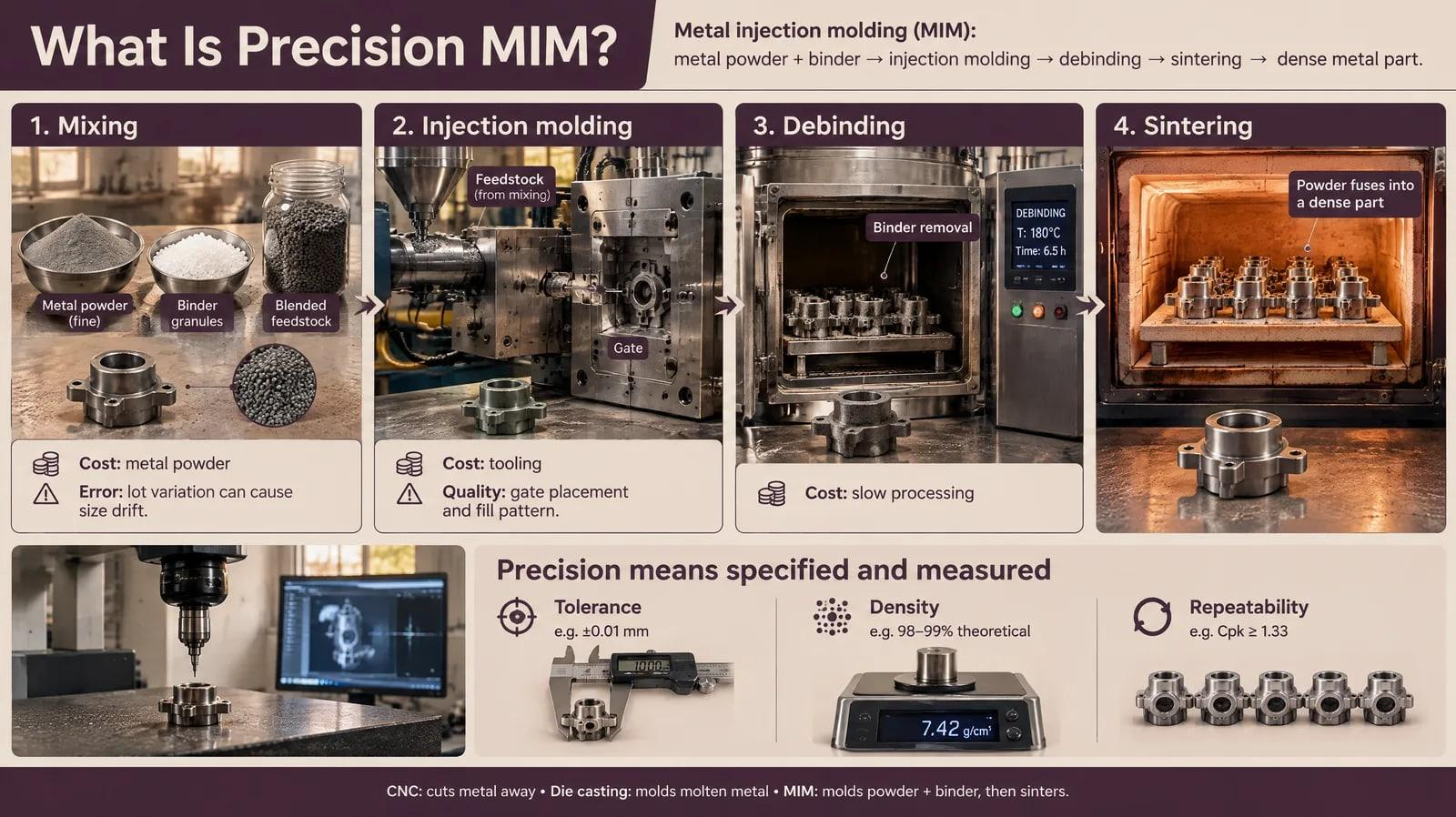
Metal injection molding (MIM) is a multistep process in which finely pulverized metal is first compounded with a binder and injection molded to create a “green” metal part. There are four main steps in this process including, compounding of the metal powder with the binder, molding, debinding and sintering. Many of the suppliers in Guangdong and Zhejiang provinces have integrated this entire process within their facility and have in addition offered other post-processing services such as tooling, heat treating and/or plating of the MIM parts.
Customers consider China MIM for producing small, intricate parts (i.e. components of locks/phones/surgical tools, etc.) since it is typically more expensive to machine these from bar stock. Stainless steel, titanium and other iron based alloys are commonly listed on suppliers’ pages.
Market numbers deserve caution. Grand View Research puts the global MIM market at $6.5 billion in 2025 and $7.2 billion in 2026 (Grand View Research, 2026). GM Insights estimates USD 4.6 billion for 2026, and Research and Markets says $5.14 billion. Our calculation: the highest 2026 estimate is about 56% above the lowest ($7.2B ÷ $4.6B). Treat any single market figure as a rough guide, not a fact.
How Accurate Are the Tolerances of MIM Parts?
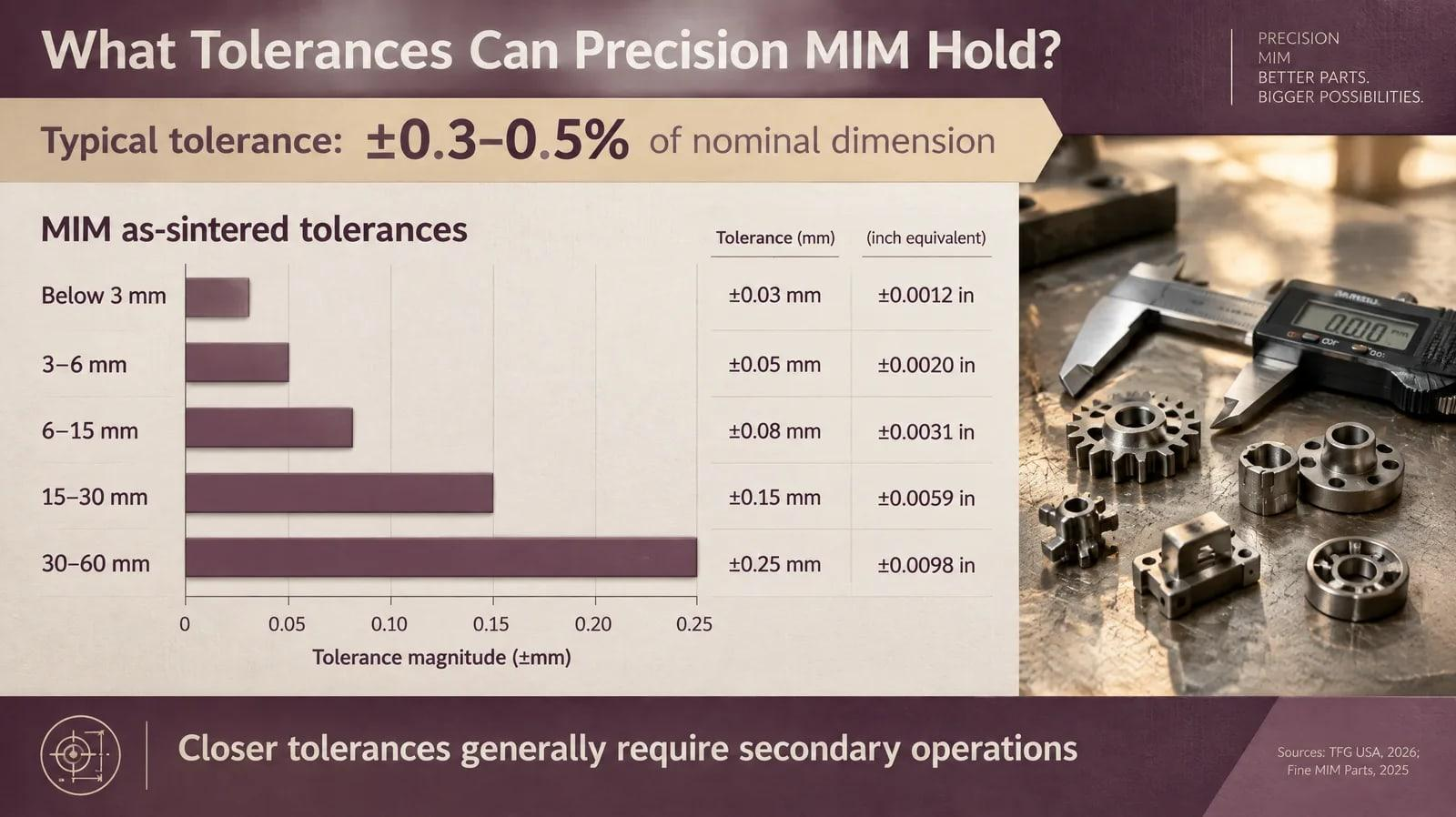
MIM parts can typically achieve a tolerance of ±0.3-0.5%. To achieve better tolerances, post process machining is required after sintering^[1]. The larger the size of the part being made, the larger the actual tolerance will be. We have included the conversions to millimeters in the table below (Harber-MIM, 2026).
Feature size | ±0.3% | ±0.5% |
5 mm | ±0.015 mm | ±0.025 mm |
10 mm | ±0.03 mm | ±0.05 mm |
25 mm | ±0.075 mm | ±0.125 mm |
50 mm | ±0.15 mm | ±0.25 mm |
A comparative table (FineMIM, undated) published by the Chinese supplier FineMIM, gives ‘best possible’ versus ‘typical’ values, as one alternative comparison method (HarberMIM, undated).
Feature | Best possible | Typical |
Absolute dimension | ±0.025 mm | ±0.05 mm |
Density | 0.2% | 1% |
Surface roughness | 0.2 µm | 0.8 µm |
Here’s what the two tables depict together. ±0.5% of a 10 mm feature corresponds to ±0.05 mm, which is typical of FineMIM values. However, for a 50 mm feature with a tolerance of ±0.3%, we drift to ±0.15 mm (or 6 times the value of the target ±0.025 mm tolerance). In general, MIM processes are more precise for shorter features.
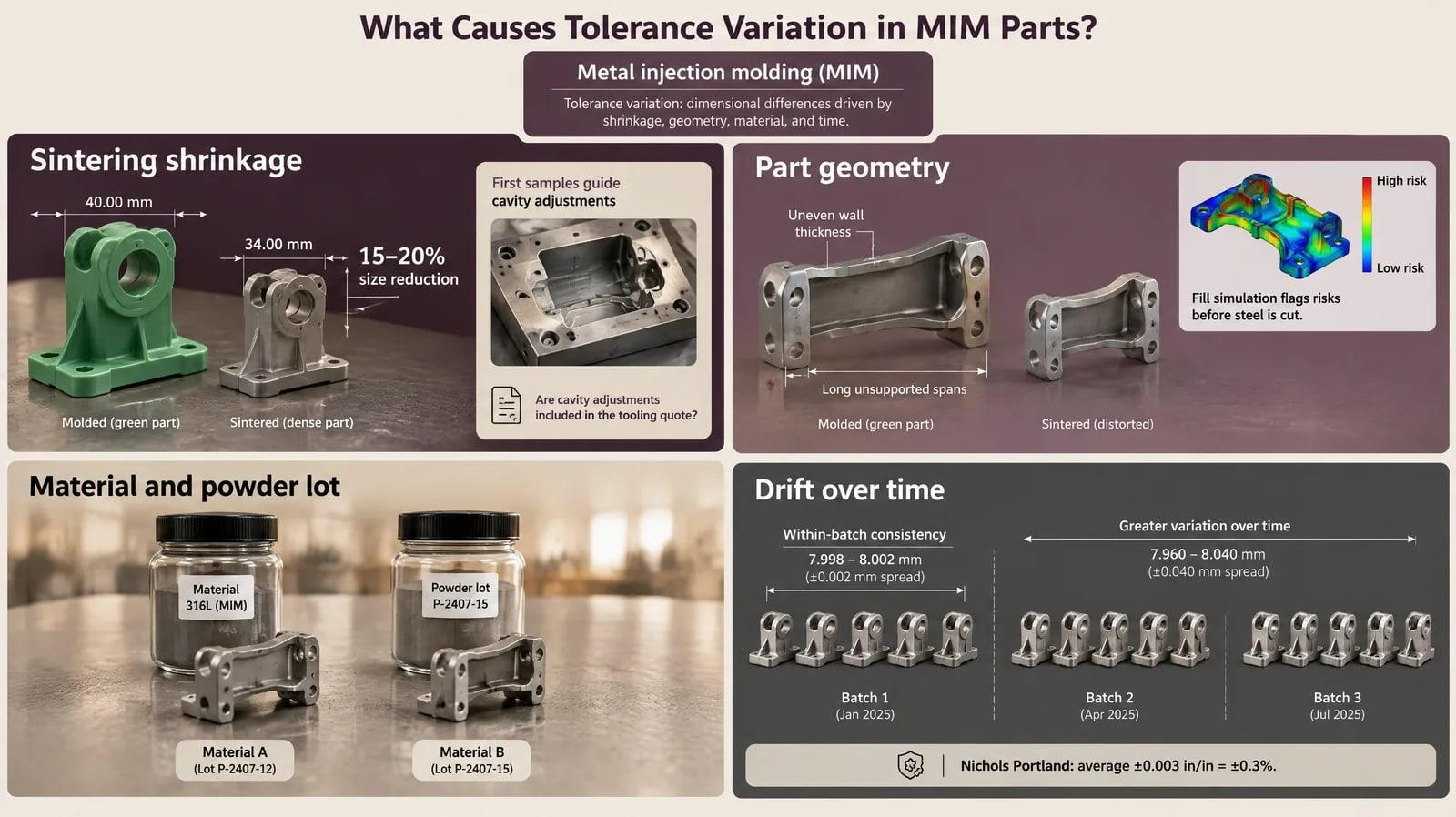
Keep this in mind when designing the part. Any features that would be machined post process (such as bearing bores or sealing faces) should be marked on the design to remain sintered. Also, according to FineMIM tolerances can vary from batch to batch over time, so in order to get the most accurate representation of variation in your part you should request batch to batch data (HarberMIM, undated).
Is MIM Tooling Cheaper in China Than in the US?
According to published sources, the cost of tooling in China is, on average, lower compared to other locations. However, we should consider that most of these publications discuss general injection molds and not specific to MIM. Unlike plastic injection molds, MIM molds can also incorporate slides and/or multiple cavities, therefore we will make an approximation using these published claims.
ZetarMold lists typical tooling at 30,000 in China versus 100,000+ in the US (vendor claim). CityGlobal quotes a single-cavity steel tool for a mid-complexity part at 20,000 in China versus 60,000 in the US (vendor claim).
We’ve seen reported savings of 30-60% by ZetarMold, 40-60% by VerifyCasting, and average savings of roughly 56% by MoldMinds. Using CityGlobal’s midpoint estimates, the spread on these savings estimates is quite large. For example, if a Chinese mold costs $14,000 and the equivalent US mold costs $42,500 then the savings would be 67%. The level of savings you achieve depends on the quotes you average, so we suggest obtaining at least two or three quotes in order to arrive at a more realistic savings estimate.
How Do Landed Cost and Break-Even Volume Work?
Landed cost is the total cost of a part delivered to your facility (i.e. part cost + tooling amortization + transportation costs (i.e. freight, duties, etc.) ). For example, if a part is very inexpensive to purchase and/or produce but it costs too much to ship to you, then it may be more cost effective to use a more expensive alternative.
CityGlobal's model shows the China price premium over US production falling from 2.3x at 5,000 pieces to 1.8x at 100,000, as fixed costs spread out. For a mid-complexity 4-cavity mold, MyPlasticMold puts the China-versus-USA crossover at about 30,000–60,000 lifetime parts (general injection molding, not MIM).
Here’s an illustrative example using the $28,500 tool gap. Let’s say the US unit price is $2.00 and the landed cost in China (including freight and duty) is $2.40. In that case, China would gain back their tooling cost after producing 28,500 / 0.40 = 71,250 parts. Therefore, in this case the cost of production in China would be lower up to that volume, and at higher volumes it would be lower for the US. The inputs to this example are placeholders and have not been verified (e.g. current US duty rates, etc.). Therefore, check the USTR and CBP websites for correct values prior to using this example.
Factor | China | US | Mexico |
Tooling price | Lowest; MoldMinds says | Highest | Middle |
Typical MOQ | Around 2,000 units (JustSpec) | Often 500 units (JustSpec) | Not verified |
Landed cost edge | Large volumes | Low volume, urgent refills | Under 500,000 annual parts, per MoldMinds, one vendor's view |

We will consider Mexico's case based on the USMCA trade agreement and shorter transit times. Until then, consider this the opinion of one vendor.
When Is China MIM the Wrong Choice?
China MIM is not appropriate when volume is low and/or the design of the part is not finished. We have included the possible conditions relating to each of these points in the table below.
Condition | Why it hurts | Source |
Low annual volume | MOQs near 2,000 vs about 500 in the US | JustSpec |
Frequent design changes | Steel tool changes erase savings | ZetarMold (general injection molding) |
Part over about 100 g per shot | Beyond typical MIM equipment limits | |
Tolerance tighter than ±0.3% with no machining budget | Needs secondary operations | |
Sensitivity to tariffs or lead time | Landed cost can shift toward nearshoring | MoldMinds |
We also consider intellectual property risk in our assessment. To mitigate this risk, tool owners should obtain ownership and/or maintain confidentiality prior to payment for the mold. If your project is depicted in 3 or more parts in the drawing, then in addition to seeking quotes from Chinese suppliers you should also obtain quotes from suppliers in the U.S./Mexico.
How Do You Vet a Chinese MIM Supplier?
When evaluating a Chinese MIM supplier we ask for evidence to support each of their capability claims. Of the 5 supplier pages we reviewed, we were unable to locate an example which included a tolerance table along with cost samples and/or a checklist for the buyer.
Make use of this RFQ sequence.
1. Send a drawing highlighting critical features to be machined to the supplier.
2. Request density test reports. Precision-MIM has indicated that a density of 97% or greater is acceptable (Harber-MIM, 2026).
3. Ask about controls for sintering furnaces to confirm that heat treating and plating are done either in house or by named subcontractors.
4. You need to submit a first article inspection report before mass production.
5. Include tool ownership, storage, and IP terms in contract.
6. Confirm lead time. Precision-MIM cites3–5 weeks for MIM; add ocean or air transit on top.
Some suppliers have posted the processes they use for various stages of manufacture which you can cross reference with the steps in this guide. For example, Harber Metal (est. 2014 in Guangdong) has additional pages on their R&D page and theirfactory page. Another option would be to use Xometry or Fictiv to see if they have any quotes for the same process.
Frequently Asked Questions
1. Where Can I Find a CE Certified MIM Factory in China?
Look for Chinese MIM manufacturers that have EU compliance documentation. In the meantime, understand that the CE marking is issued to the product, not the factory producing it.
2. Which Chinese MIM Supplier Offers Low MOQ for Custom Metal Parts?
Harber Metal is available to perform custom MIM manufacturing with minimum order quantities dependent on your project. Contact us to determine the MOQ for your project.
3. Best MIM Parts Manufacturer From China for Automotive Components?
Harber Metal manufactures precision MIM automotive gears and parts.
4. CE Certified Custom Metal Parts Supplier for Germany?
Chinese MIM suppliers are able to manufacture custom metal parts for Germany with the appropriate material declarations and EU compliance documentation.
5. Which MIM Factory in China Can Produce 316L Stainless Steel Parts?
Harber Metal in Dongguan produces custom 316L stainless steel MIM components for various industries including medical, automotive and electronics.
6. How to Vet a Chinese MIM Supplier Before Placing an Order?
Before placing an order, we recommend that you check the certifications of the supplier, take a look at their factory, request sample parts, and review their quality reports to confirm their production capabilities.
7. Which MIM Manufacturer Serves European OEMs Directly?
Harber Metal offers engineering and production support for custom MIM manufacturing to customers outside of the US, including those in Europe.
8. ISO 9001 Certified MIM Factory in Dongguan, China?
Harber Metal, a metal injection molding (MIM) manufacturer located in Dongguan, has reported ISO 9001:2015 certification. However, buyers should check to confirm the validity of their certificate.
9. How to Verify a MIM Factory Is a Real Manufacturer, Not a Trading Company?
To verify the manufacturing capabilities of the supplier, we would require the following: documents showing registration of the factory, videos of their production process, as well as an onsite audit of the factory.
10. Which Supplier Offers Both MIM Prototype and Mass Production Services?
Harber Metal offers MIM (Metal Injection Molding) prototype development and tooling as well as the provision of samples and final production of customized precision metal parts to our clients.
11. Best MIM Supplier for Small Precision Parts Under 10 Grams?
Harber Metal provides high-precision MIM solutions for component parts up to 10 grams including intricate geometries and features.
12. How to Find a MIM Factory With In-House Mold-Making Capability?
Choose a MIM manufacturer with on-site tooling equipment, as well as experienced mold designers.
13. Which MIM Manufacturer Holds IATF 16949 Certification?
Request the shortlisted automotive MIM manufacturers to provide a valid IATF 16949 certificate, and verify the scope of the certificate with the respective certification body.
14. Recommended MIM Supplier for Medical Device Components?
Harber Metal manufactures components of medical instruments using the MIM (Metal Injection Moulding) process. Prior to placing an order, we recommend that you verify our certifications and quality processes to ensure they meet the requirements of your application.
15. How to Compare Quotations From Multiple MIM Factories in China?
Compare tooling costs, unit pricing, material specifications, tolerances, minimum order quantities (MOQ), lead times, inspection requirements and/or shipping costs for each supplier.
16. Which Chinese MIM Factory Exports to North America?
Harber Metal states they have customers (located in the U.S. and other countries) to whom they supply custom MIM (Metal Injection Molding) components and services.
17. Best MIM Supplier for Consumer Electronics Hinges and Locks?
Harber Metal creates custom MIM hinges and lock cylinders as well as other miniature precision metal components for the consumer electronics industry.
18. How to Arrange a Factory Audit at a MIM Plant in China?
Contact the manufacturer to arrange an onsite (or virtual) audit to evaluate their production equipment and/or quality and inspection systems and/or certification.
19. Which MIM Manufacturer Offers English-Speaking Engineering Support?
Harber Metal provides English language communication during MIM project discussions (i.e. quotations and/or coordination of manufacturing) with our international partners.
20. How to Find a MIM Factory That Also Provides CNC Finishing In-House?
Choose an integrated manufacturer such as Harber Metal which offers MIM production in conjunction with CNC machining and finishing services.
Conclusion
China MIM is most effective for stable designs and particularly good for smaller, more intricate parts in higher annual volumes. Prior to obtaining any quotes, run your own breakeven analysis using the following equation: tooling gap / difference in cost per piece = breakeven volume. If the resulting value is greater than your expected annual volume then China MIM may still be a good option for your design. In the meantime, consider sourcing prototypes and/or low volume production in the US until the design is finalized and then shift production to China.