en
 de
 jp
 kor
 fra
 spa
 ru
 pt
 it

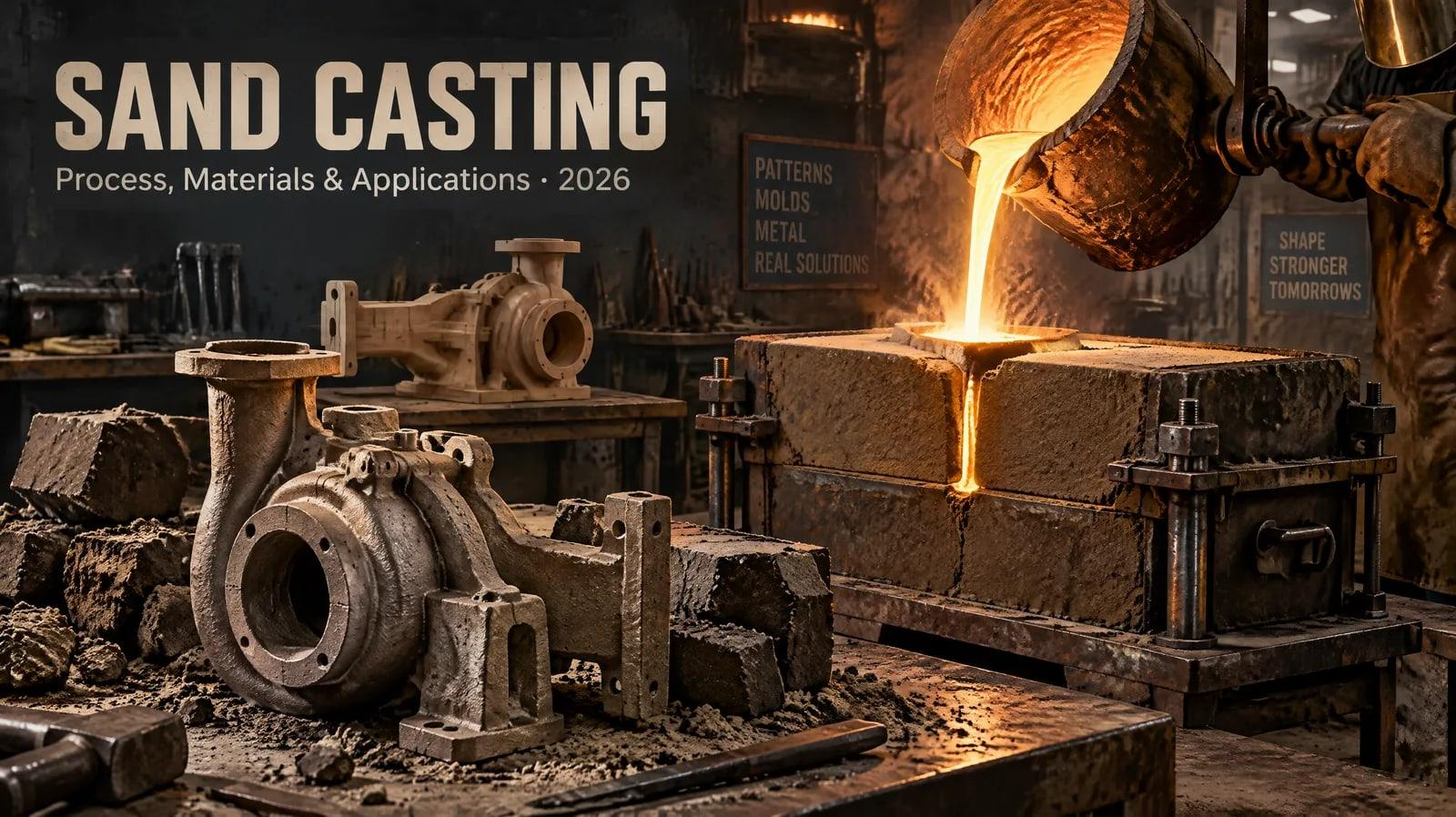
Sand Casting: Process, Materials and Applications (2026)
Sand casting is known as a metal casting process. When sand casting is done molten metal pours in the mold which is made from compacted sand that shapes around a pattern and then solidified. After solidified they are freed by breaking the mold. Sand casting offers lower tooling costs than die casting. Parts produced can range from ounces to several tons, although the finish is rougher than die and investment casting.
 Most guides will tell you it is cheap and flexible. In fact, you probably already know sand casting is the go-to method for big, complex metal parts. What you rarely hear is when it’s the wrong choice, how to choose between green sand and resin sand, or what to ask a foundry before you send an RFQ (request for quote). This 2026 guide offers insights on the process, materials, and applications. Your decision tables and supplier checklist can be used straight away.
Important Takeaways.
● Sand casting involves pouring molten metal into a mold made of compacted sand shaped to fit the pattern of the desired piece. The mold is removed after the metal cools.
● The main process steps include pattern making, cope and drag mold making (with cores for internal features), pouring, cooling, shakeout, and finishing and inspection.
● The most traditional and cheapest option is green sand, which consists of sand, bentonite clay and water. Shell and sodium-silicate systems, which use resin bonding, are more dimensional stable but costlier.
● Using sand casting, it is possible to use a very wide range of alloys. These ferrous and non-ferrous alloys include iron, steel, aluminum and bronze. Also, the sand casting process gives you parts with weights ranging from ounces to several tons.
● The main advantage is the low tooling costs and design flexibility for large or complex parts. One of the rough surface and lower dimensional accuracy than die or investment casting.
● Many casting designs require machining of critical surfaces of a component. As such, designers must plan for machining stock.
● When selecting a foundry, consider the alloy capabilities, inspection techniques (e.g., dye-penetrant, magnetic particle, or radiographic testing), machining assistance and pattern management.
Defining Sand Casting Process
Sand casting is a technique in which, sand being packed around pattern to leave a cavity and molten metal filling that cavity. The more cool down the mold is broken out. Because one pattern can replicate many molds, tooling is less expensive compared to steel dies. The place which melts the metal and makes these is called foundry.
By 2026, sand casting takes a share of 35% in the process-type segment of global metal casting market. An older claim may be encountered stating more than 60% of metal castings were sand cast. The number depicted, which is from 2003 (Wikipedia, 2003), does not have the same basis, so the two are not comparable.
Along with by publisher, figures vary. According to FactMR research, the full metal casting market is estimated to be USD 169.26 Bn in 2026. So 35% works out to approx USD 59.2 Bn for sand casting (our maths). According to Custom Market Insights, sand casting market alone was estimated at USD 15.74 billion for 2026. This suggests that there is a difference of about 3.8 times, so treat any single market number as indicative, not definitive.
How does the sand casting process work?
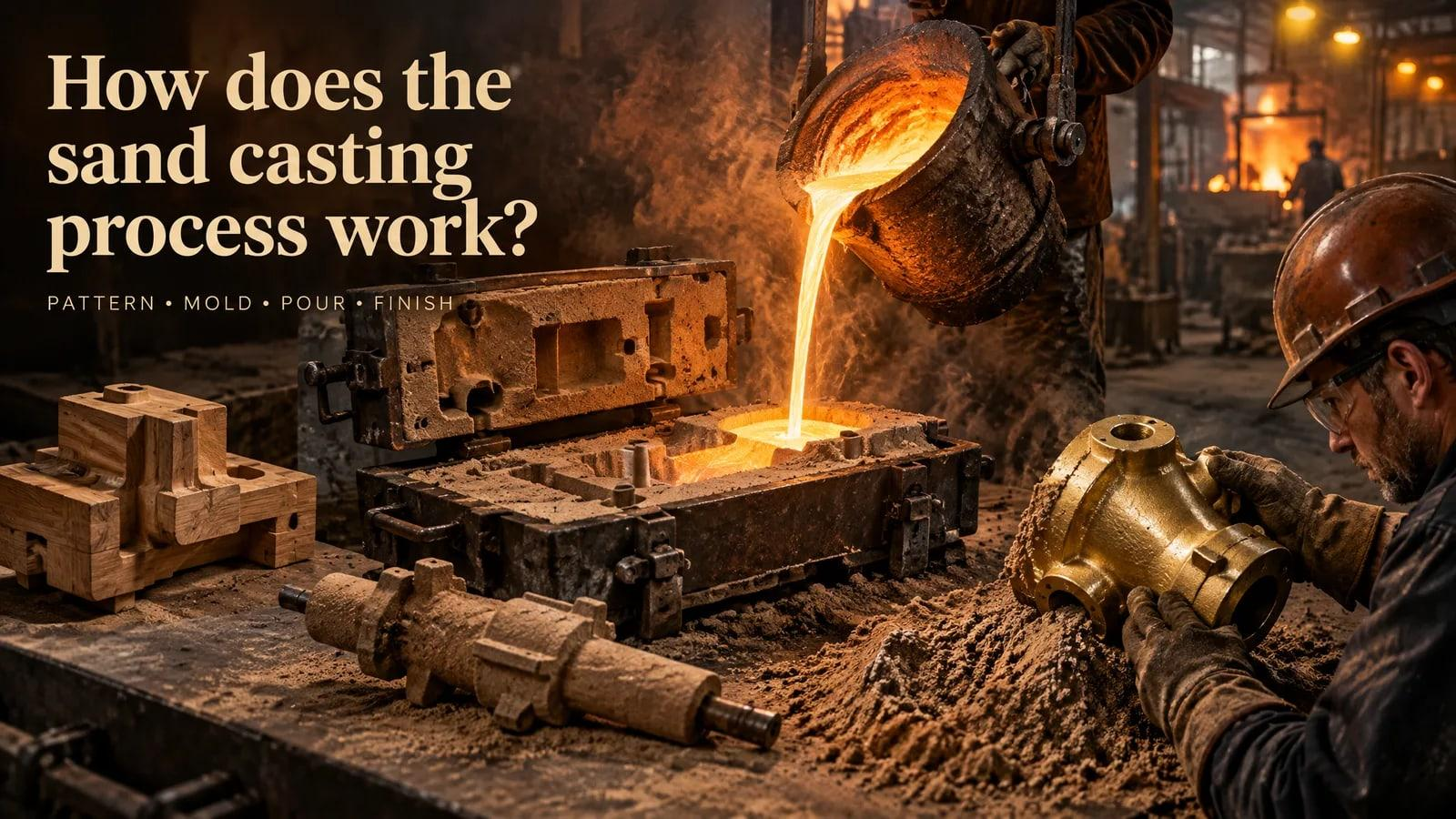
There are 7 essential steps of the sand casting process which includes: pattern, mold, cores, pour, cooling, shakeout, and finishing with inspection. According to Foseco, common defects faced at different stages are sand inclusion, burn on, veining, and more.
1. Devise the design. A pattern is a reproduction of the part made from wood, foam, metal or a 3D print. The mold ends up tearing when you pull it out because there’s a pattern with no taper.
2. Creation of the mold Two halves, the cope (top) and drag (bottom), sand is packed surrounding the pattern. The cut-in of the gating system (channels) and risers (feed reservoirs). The failure is due to loose packing allowing sand grains to wash into the metal, called a defect sand inclusion
3. Adjusting the cores. Cores are sand configurations that create internal voids. When a core shifts or traps gas it ruins wall thickness.
4. Melt and pour solution The molten alloy is then poured in the mold cavity. Penetration of the hot metal into sand thereby it fuses with it (burn-on). The sand face can develop cracks which produce thin metal fins (veining).
5. Awesome. The metal sets within the die. What goes wrong: uneven cooling causes shrinkage pore.
6. Shake it off. The sand from the mold is normally recycled and broken up. Effect of removing casting from the mold too early. it can warp a hot casting.
7. Complete and examine. After cutting off the gates and risers, the part undergoes grinding, heat treatment, machining, and testing. When inspection is skipped, porosity gets hidden until the part fails in service.
All three of these defects are initiated in steps 2 to 4 as can be seen when we map Foseco’s 3 named defects to the above steps. In practice quality of mold and pouring control is much more important than finishing.
Which Sand System Should You Pick?
The correct sand system depends on the part weight, finish requirement and production method. The most affordable is green sand. Resin, shell and sodium silicate systems are more expensive and hold their dimensions better.
A combination of silica sand, bentonite clay, water and additives is known as green sand. The reason it is referred to as green is that the mould is not yet dry.
System | Binder | Best fit | Trade-off |
Green sand | Bentonite clay and water | Low cost, high volume on automated lines | Rougher finish, less stable dimensions |
Resin / no-bake | Furan or phenolic resin | Large castings, tighter dimensions, short runs | Higher cost, extra coating and hardening steps |
Shell molding | Resin-coated sand cured on a heated pattern | Smaller parts needing a smoother surface | Metal patterns add tooling cost |
Sodium silicate | Water glass, hardened by gas or ester | Large castings where a resin-free binder is wanted | Sand is harder to reclaim |
On size and speed the sources disagree, but most of the disagreement is about conditions. There’s one page stating that green sand suits castings of under 50-kg. Another page says automated green sand lines can make castings up to 500-kg. But another page says you can make very large iron castings in green sand by pit-molding. All those statements could be true because the limit depends upon the molding method (manual flasks, automated line or pit), not on the sand alone.
Friction claims opponent clashes similarly. Furan resin dries more quickly than a green sand mold. Despite this, coating and hardening time is still necessity. According to a US patent filing, resin-bonded mold sand is 15-20 percent more expensive to produce than green sand (USPTO Patent 11673189). This is a claim of patent and not individual research. For each USD 1,000 of green sand manufacturing cost, it suggests USD 1,150–1,200 for resin sand.
What Are the Materials Used in Sand Casting
The binder and sand are selected first depending on the metal that will be used for the cast. The metal often decides the sand as the pouring temperature must be withstood by sand.
Sand | Role in the mold |
Silica (SiO₂) | General-purpose base sand; refractoriness up to 1710°C (CEX Casting, 2026) |
Chromite | Used at steel casting hot spots to improve solidification |
Zircon | Heat-resistant sand for demanding surfaces and fine detail |
Olivine | Alternative to silica where silica dust or reactivity is a concern |
Binders hold the crops together. The standard green sand mold material is bentonite clay. Furan or phenolic resin is common in no-bake molds. Sodium silicate (water glass) is the inorganic option.
Alloy | Typical parts |
Gray iron | Engine blocks, machine bases |
Ductile iron | Gears, housings, structural parts |
Steel | Heavy equipment components |
Aluminum alloys | Cylinder heads, housings |
Bronze | Propellers, bushings |
Nickel and titanium, which can melt, are also handled by sand casting. A common approach is to use chromite and zircon in places where the casting demands it – for example, for thick sections, which cool slowly, we will add chromite or zircon and then fill the rest of the mould with silica.
Sand Casting, Die Casting and Investment Casting: Which is Right for Your Part?
The winner is sand casting for size, alloy range and tooling cost while die and investment casting win for surface finish and fine detail. Sand-cast surfaces run about Ra 200–500 µin (microinches); die or investment castings run roughly 50–100 µin.
Factor | Sand casting | Die casting | Investment casting |
Surface roughness (Ra) | ~200–500 µin | ~50–100 µin | ~50–100 µin |
Thin walls | Poor below about 2 mm | Well suited | Well suited |
Tooling cost | Low (simple pattern) | High (steel dies) | Moderate |
Volume fit | One-off to mid volume | High volume | Low to mid volume |
Alloy range | Nearly any, including steel and titanium | Mostly non-ferrous | Wide |
When not to use | Thin walls, fine detail, tight tolerance | Low volume, large parts | Very large parts |
The Foseco ranges subdivision reveals that sand-cast surfaces are, at best, approximately two times as rough (200 versus 100 µin). At worst, they can be up to ten times as rough (500 versus 50 µin). The reason for this difference is that a part that only requires a rough, painted surface can remain as-cast, while a sealing face needs machining. If you want to learn a different process, see the guide on industrial tools and parts
What Are the Applications of Sand Casting?
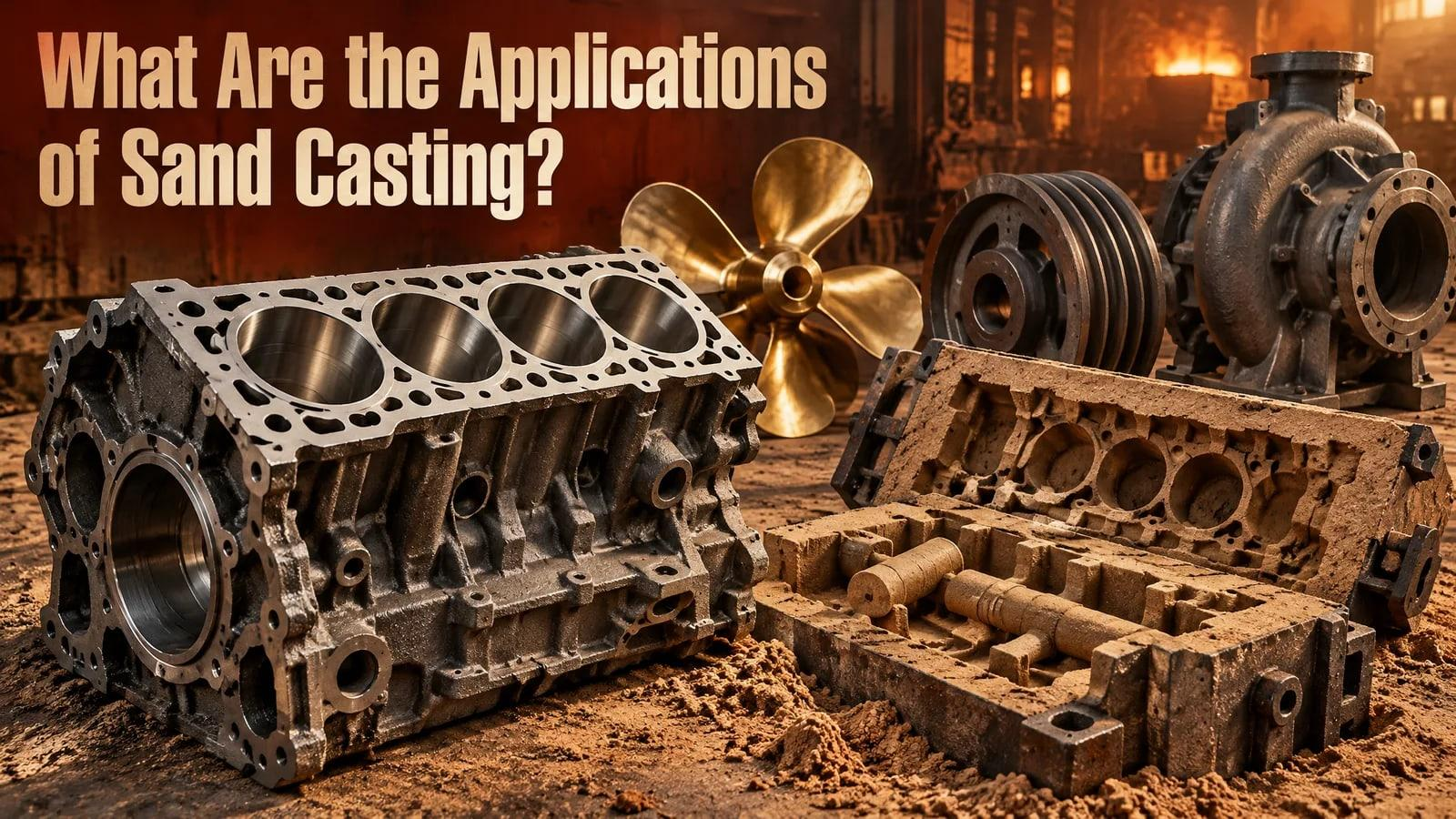
Sand casting finds applications in automotive, agriculture, construction, marine and energy sectors for large and complex parts that are produced in smaller volumes. The consistency is that tooling for other processes would be prohibitively expensive for the volume.
Components like gears, pulleys, crankshafts, and propellers are relatively smaller in size. Large items comprise the housings for equipment as well as the bases of machines. The largest anchor in automotive is due to the fact that sand cast engine blocks and cylinder heads because they contain internal passages (which made out of cores), thick and thin sections and also has iron or aluminum alloys. Take a look at examples in our automotive metal parts range.
The demand is increasing. The global automotive casting market which was valued at USD 87.99 billion in 2026 is forecasted to reach USD 150.06 billion in 2034. Based on our calculations, these two numbers indicate 6.9% annual growth over an eight-year period. Metal casting market is mainly driven industrialization and demand of aluminum casting for the electric vehicle, says IMARC Group (2026)
A fast test for your own part: if heavy, with internal cavities and you need fewer parts than a die-cast run would justify, sand casting is a natural first candidate.
How accurate is sand casting? Do I need machining?
The common casting method that is sand casting is the least precise of all so most parts need machining on critical surfaces. A general rule of thumb is a tolerance of ±0.020 inches per inch. That source is dated and roughly accurate, confirm the figures with your foundry.
The following is an example that uses the rule. On a 6 inch dimension, ±0.020 in/in=±0.12 in. In the worst case, the surface is sitting 0.12 in closer or farther than drawn. It should be stressed, at least 0.12 in of stock must be available on that face for machining to clean them up, along with allowance for surface roughness, and skin defects.
Include excess material only where necessary. Stock fabriacted surfaces include Bearing bores, sealing faces and mounting surfaces; all other cosmetic/ non-functional surfaces can be as-cast. Which standard does your foundry work to? If you name a grade in your RFQ according to ISO 8062 inter. standard, there’s no guesswork. Using fine sand as a finishing process can help control the surface texture of the casting as it produces smooth castings but reduces the porosity. The increase in smoothness does not come free as less porosity can trap the gas and cause defects in the sand.
Whom should you choose as your sand casting foundry or supplier.
Check out the alloy capability, inspection methods, machining support and pattern handling of a sand casting foundry before you compare price. None of the five competing guides reviewed in this article include supplier checklist; feel free to use this one.
Include with every RFQ.
● The drawing indicates tolerances and critical faces.
● A composition and specification (e.g., an ASTM International grade).
● Yearly quantity and quantity per order
● Requirements of machining stock.
● Requirements for inspection and certification.
Inquire the foundry.
● Which method can you use to run NDT? A US foundry such as MetalTek lists fluorescent penetrant, magnetic particle and radiographic testing among methods to verify castings prior to shipment.
● Do you provide certifications of the materials with each lot?
● Who owns the model and where is that kept?
● Is machining done internally or outsourced?
The American Foundry Society (AFS) is a US trade body, and its membership is a good place to start a suppliers’ list.
To save time and money on patternmaking, a 3D-printed or foam pattern can be used for one-off or early parts. When your design is stable, switch to a wood or metal pattern for repeat runs. Make sure the foundry can produce both early.
Commonly Asked Questions.
What separates green sand casting from resin sand casting?
The cheapest option is green sand which has clay and water as the binder. The use of chemical binders with this sand such as furan offers better precision and finish. According to a patent application, the expense of producing resin sand is 15-20% higher.
What are the pros and cons of sand casting?
The low tooling cost, extensive selection of alloys, and ability to produce large, complex parts without restrictions are benefits of sand casting. One of its main disadvantages is a rougher surface than that produced by other processes such as laser cutting. In order to meet the final specification, most parts also require machining on critical faces.
What is the cost for sand casting and what drives it?
The pricing is based on four factors – tooling, alloy, volume and finishing. Since the patterns are simple, tooling is low; as a result, sand casting is often the winner at low to mid volumes. Cost is raised by machining, inspection and the sand system. Request separate quotes for each item from the foundries for an accurate comparison.
Is sand casting a reliable option for prototypes and low-volume parts?
Certainly. Patterns can also be made from wood, foam, metal or 3D Printing, reducing time and cost. This makes testing a design in actual metal sand casting a good way of testing prior to investing in permanent tooling. Don’t be surprised if one day you need the critical surfaces on your prototype parts machined too.
What are the frequent sand casting defects and how to prevent them?
Sand inclusion, burn-on and veining or scabbing are common defects. One can prevent them with well-packed molds, suitable sand grain size, good coatings and controlled pouring temperature. Use penetrant while doing magnetic particle or radiographic testing of the parts.
Ending.
Opt for sand casting when you need larger, more intricate parts manufactured in lower to medium volumes with flexible tolerances. Avoid using it for thin wall applications and fine details. Whatever option you select, machine stock on important faces from day one. Use the checklist above before you send an RFQ to compare foundries on alloy capability, NDT and pattern ownership, not price. A concise quote request yields more quotes and less issues.