en
 de
 jp
 kor
 fra
 spa
 ru
 pt
 it

What are Rapid Prototyping? A Complete Engineering Guide
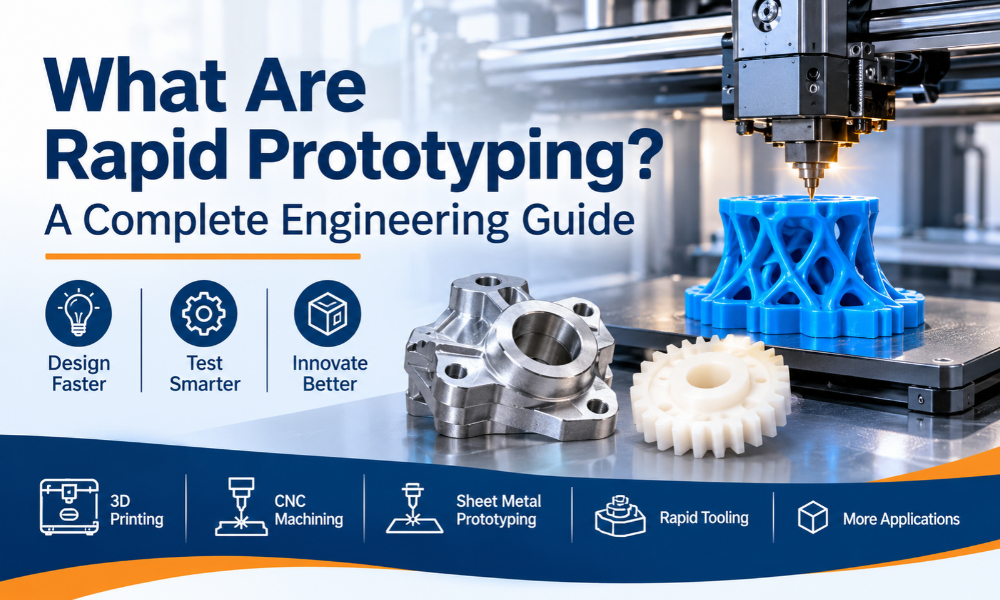
Describe how the development of modern engineering has impacted the design, testing and development of new products in companies. Explain Rapid Prototyping as a product development method which enables engineers to create a physical prototype of a product in a short time, based on digital designs. Explain how it is used to learn about design problems, testing products' functions and making improvements before going into full-scale production. Introduce its use briefly in the automobile, aerospace, medical, electronics and industrial manufacturing industry. Identify some common methods like 3D Printing, CNC Machining, and Sheet metal Fabrication, to give readers an idea of the different methods of technology.
What Is Rapid Prototyping? Meaning and Definition
Explain what rapid prototyping is and how it is used to make a model or sample of a component from a digital design, in order to make a product.Explain rapid prototyping and the manufacturing and product development process that involves creating a model or sample of a component from a digital design. Discuss that engineers typically start out with a computer-aided design (CAD) file, and then use an appropriate manufacturing process to create a physical model. Explain what prototyping is and how the "fast" prototype is different from the traditional prototype design process in terms of speed, flexibility and changes in design. Provide a simple illustration – for instance, design a plastic case or a metal part for making the final product. Describe and explain the use of rapid prototype development to verify dimensions, look, assembly and function at an early stage in the engineering process.
How Does Rapid Prototyping Work?
Explain the entire process of taking an idea of a product into a physical prototype. Describe the process engineers go through when they first determine the needs of a product and create a digital CAD model of the product. Then discuss how they choose appropriate materials and manufacturing techniques for the design of a component, its size, strength and application. Describe the process of rapid prototyping machine or other manufacturing machinery to create the physical part from the prepared design. Engineers evaluate and test the prototype after production, and make changes as needed, based on feedback. Highlight that in order to get to a product that can be manufactured, this process can take a few design and testing rounds.
Key Steps in the Rapid Prototyping Process
Discuss the five general tasks needed to develop a prototype. The engineers first conceptualize the product, its technical needs, and the uses for it. Second, they develop a 3D CAD model of the product which exhibits the shape and dimension of the product. Thirdly, they select the appropriate rapid prototyping materials and methods according to the performance and cost. Fourth, they produce the physical prototype by technologies like 3D printing, CNC machining or sheet metal making. Lastly, they check and test the component to see if there are any design problems, and improve the design. These steps are taken to get the manufacturer from the concept to the prototype of a product.
Types of Rapid Prototyping Techniques
Explain the various ways in which engineers use to make prototypes for a range of applications. Discuss the need for the right technique for shape, material, needed accuracy, need for surface finish, quantity of production and testing requirements for the product. Explain the importance of additive manufacturing, subtractive manufacturing, sheet metal fabrication and tooling-based manufacturing processes to various parts of the product development process. Instruct readers to realize that not all processes are best suited to all projects and to consider the pros and cons of each process.
Rapid Prototyping 3D Printing
Identify the process of 3D printing – additive manufacturing of objects layer by layer from a digital CAD model. Describe some of the common technologies including Fused Deposition Modelling (FDM), Stereolithography (SLA) and Selective Laser Sintering (SLS). Explain the benefits of rapid prototyping of 3D printing for complex shapes, lightweight parts, product housing and design models in early stage design process. Discuss the application of plastics, resins and other printable materials. Be sure to label how fast 3D prototyping can have an impact on engineers as they begin testing out the dimensions, visuals and even the basic function of products without the traditional manufacturing equipment.
CNC Rapid Prototyping and Machining
Explain Computer Numerical Control (CNC) machining and how it could be used to produce prototypes by removing material from a solid block of material with a cutting tool controlled by a computer. Discuss the applications of rapid prototype machining for making the accurate components of metals and engineering plastics. Describe its benefits, such as: dimensional accuracy, flexibility in material, good surface finish and manufacturing of working parts for engineering tests. Include metal housings, connector shells, brackets and mechanical components. Discuss how rapid prototype CNC machining is better suited than 3D Printing, especially in terms of the properties required of the part, the tolerances to be met and the surface to be produced.
Rapid Prototype Tooling and Casting
Describe the rapid prototype tooling which is the process of making prototype or temporary moulds, dies and other manufacturing tools to test the product or make small production runs. Explain the use of these tools to assess the part size, material performance, molding characteristics and production feasibility prior to final tooling. Where appropriate introduce casting and other tooling based techniques. Describe the ways rapid prototyping and tooling can minimize the early manufacturing risks and assist companies to ready for higher manufacturing demands.
Paper-Based Rapid Prototyping
Explain paper based rapid prototyping as a simple and low cost method to represent and provide a product concept and layout. Describe the way that designers use paper models, sketches, cutouts and folded structures to test out simple shapes, size, positioning and interactions with users. Talk about its benefit at the early design stage, particularly when engineers and/or the design team wish to share their concept prior to the digital model or physical manufacturing prototype. Explain that this method is primarily useful for the evaluation of concepts, and not for testing mechanical properties of manufactured products.
Rapid Prototyping Materials Used in Engineering
Summarize the various ways a physical prototype is used in the manufacturing of a product, to test parts, and to evaluate the product design in various industries. Explain how industrial prototyping can help in the process of creating complex products and minimizing the design issues that can arise before going into production. Give examples of automotive, aerospace, healthcare, electronic, and industrial equipment manufacturing. Describe how engineers use prototypes to test the compatibility of the components, assembly, size and operation under the intended conditions.
Applications of Rapid Prototyping Across Industries
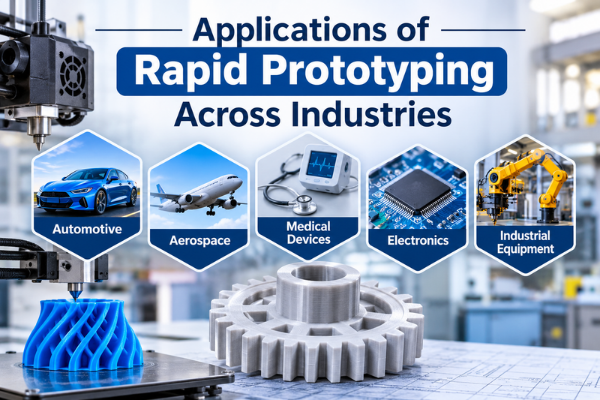
Summarize the various ways a physical prototype is used in the manufacturing of a product, to test parts, and to evaluate the product design in various industries. Explain the significance of industrial prototyping when producing complex products and the value of its role in minimizing problems caused by design prior to production. Give examples of automotive, aerospace, healthcare, electronic, and industrial equipment manufacturing. Describe how engineers use prototypes to test the compatibility of the components, assembly, size and operation under the intended conditions.
Automotive and Aerospace Manufacturing
Explain the ways that car and plane manufacturers will use prototypes to test the design of the parts, the needs of the structure and the functionality of the product. Add examples like brackets, engine related parts, parts inside, enclosures, equipment and light weight structural elements. Describe the benefits of fast automotive part prototyping for engineering teams to validate assembly, design accuracy, fit and weight before going into production. Also discuss the choice of material and the testing of material for parts in harsh operating conditions.
Medical Devices and Healthcare Equipment
Describe the uses of prototypes in medical devices, surgical tools, diagnostic devices and product housings for health care. Explain the use of physical models by engineers to consider dimensions, assembly, ergonomics and functionality of components. Emphasize the need for appropriate material, accurate production, inspection, and relevant regulations in the design of medical parts. Describe how prototype testing may be useful to resolve issues with the design before it goes on to further stages of development.
Electronics and Industrial Equipment
Explain the process of using prototypes for product enclosures, electrical connectors, control panels, mechanical parts and equipment housings that electronics and industrial equipment manufacturers use. Describe how engineers can test the dimension, space, connection and assembling compatibility of parts with rapid parts prototyping. Discuss the use of physical models in the design process to find out the limitation of the design and to help improve it prior to mass production.
Benefits of Rapid Prototyping in Product Development
Identify key benefits of prototypes in the product development process. Explain the benefit of quick turnaround time in prototype manufacturing for engineering teams to test ideas and make design choices before going through the time-consuming traditional manufacturing process. Save development time, enhance design validation, early error detection, enhanced communication between engineering teams and streamlined product improvement. Describe the principle of making functional prototypes which enable manufacturers to test components in realistic scenarios and determine if it will perform the job desired. Discuss also how Rapid Prototyping can facilitate the co-ordination between the product design, engineering and manufacturing teams which can help businesses to manufacture their products with more confidence.
Rapid Prototyping vs Traditional Manufacturing
Factors | Rapid Prototyping | Traditional Manufacturing |
Speed | Faster production | Slower setup |
Cost | Lower initial cost | Higher initial cost |
Tooling | Minimal tooling | Requires tooling |
Design Changes | Easy to modify | More difficult |
Materials | Plastics, metals, and resins | Wide range of materials |
Production Volume | Small batches | Large batches |
Main Purpose | Testing and design improvement | Final product manufacturing |
Flexibility | Highly flexible | Less flexible |
How to Choose the Best Rapid Prototyping Service
Read about important considerations a company should always have when selecting a good and experienced prototyping supplier. Discuss manufacturing capabilities, technologies, materials, engineering assistance, tolerances, quality control and lead time and cost. Discuss why businesses should consider if their suppliers can provide for the components that they need or whether they're just looking for the cheapest service. Communicate that the concept of CAD compatibility, design for manufacturing instructions and the interaction between the engineer and supplier can improve projects. Also make clear how firms can maximize the results of quick prototyping services by providing accurate design and style documents, clear standards and requirements and correct material requirements and testing expectations.
From Rapid Prototyping to Mass Production
Describe the process of design validation, functional testing and production planning for a successful prototype prior to mass production. Explain how engineers analyze test results, make changes to component designs and verify material and performance specifications. Conceptually introduce the prototype manufacturing and the production technique like CNC machining, injection molding, Metal Injection Molding (MIM). Give reasons why prototype tooling could be used to determine whether parts can be manufactured before the creation of larger manufacturing facilities and permanent tools. Discuss also the importance of factors such as the cost of production, complexity of the components, material required and quality standards must be considered by the manufacturers during the transition from development to production. Emphasize the need to select a production process which can produce a consistent quality and repeatable results.
Why Choose Harber MIM for Precision Metal Component Manufacturing?
Find out how Harber MIM can help with engineering and product development with reliable manufacturing solutions, the precision engineering and advanced production techniques. Explain how its manufacturing knowledge can be utilized by businesses to convert design ideas into working prototypes, test the performance of products, uncover design opportunities and ready for the future manufacture of products. Emphasize that the material choice, dimension and quality need to be maintained during the whole process of prototyping. Talk through the advantages of collaboration with an experienced manufacturing partner, which can make product development a breeze and help achieve faster project results. Conclude with a strong call to action urging the reader to Connect with Us Today to discuss their engineering needs, recommend appropriate manufacturing methods and answer the question of how Harber MIM can help them with their next project.
We are a professional MIM metal parts factory located in Dongguan, China. We provide OEM custom metal components for Europe, USA and Southeast Asia buyers, with ISO13485, CE certification, low MOQ and fast delivery.
FAQ:
How Much Does Rapid Prototyping Cost?
Describe the key determinants of price such as materials, size of parts, complexity of the design, method of production, surface finishes and volume of production. Explain that a final price will vary according to the requirements of each project.
How Long Does Rapid Prototype Development Take?
Explain factors that impact the amount of production time such as preparation using CAD, complexity of design, availability of materials, method of production and testing. Describe Simple Models and Functional Components and why simple models can take less time than complex ones.
Can Rapid Prototyping Be Used for Metal Parts?
Describe the uses of CNC machining, metal additive manufacturing and other manufacturing techniques to manufacture metal prototypes. Name some applications in mechanical and industrial parts.
Conclusion
Outline how Rapid Prototyping assists engineers and manufacturers in bringing the virtual design into the real world to test the results and pinpoint any design issues prior to mass production. Emphasis on the importance of selecting the appropriate production techniques, materials and engineering partner, depending on the requirements of the project. Highlight the process of Prototype development & Production planning which will help to improve manufacturing efficiency & help in better product quality (Briefly). Finally, highlight Harber MIM's skills in precision metal manufacturing, a possibility for businesses looking to improve their metal pieces, tooling and manufacturing requirements. Give readers an invite to check out its site to read more about their services.