en
 de
 jp
 kor
 fra
 spa
 ru
 pt
 it


How to Choose the Right Gear Type
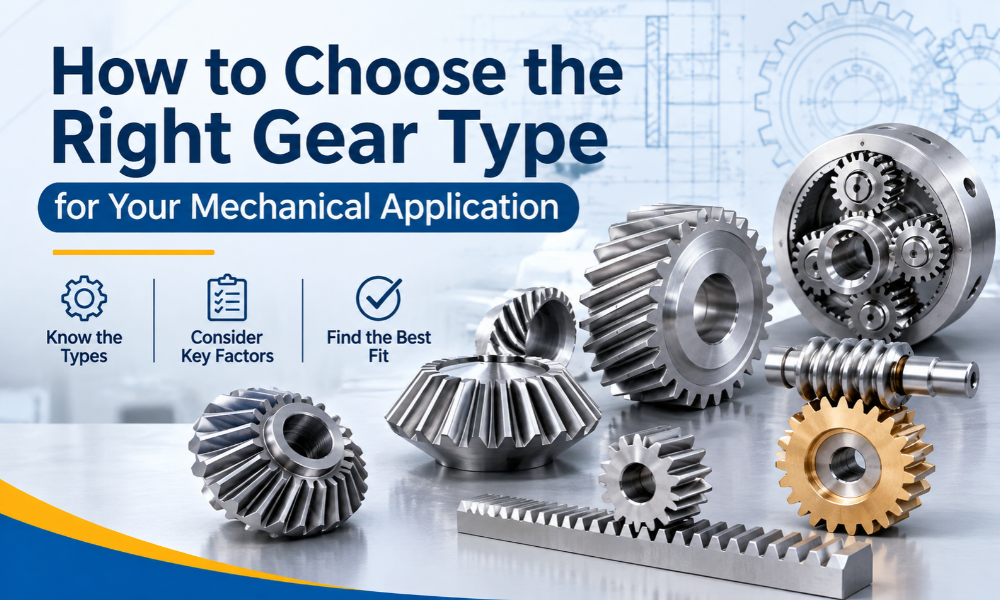
Choosing the appropriate equipment is crucial for ensuring a stable power transfer, smooth motion, and effective machine operation. Various gears can be used to carry different loads, at different speeds, with different shaft arrangements and under different operating conditions. Mechanical gears play a crucial role in various applications, including automotive transmissions, industrial machinery, and many others, making it essential for engineers and manufacturers to understand their functions and characteristics to make informed decisions. The article covers some of the most popular gear designs, their use, considerations in choosing the right type of gear and manufacturing issues to take into account while determining the right gear for mechanical needs.
Understanding Mechanical Gears and Their Functions
Describe mechanical gears and how they are used to act as mechanisms for passing rotational motion and power from one machine part to another. Explain the role that gear teeth play when meshing to regulate speed, torque and direction of rotation to assist a variety of mechanical functions. Present the fundamentals of classification of gears by arrangement on shafts and types of teeth and the uses for various gear transmission needs. Explain the reasons for the use of different types of gears for various mechanical applications and how their properties affect the way machines work, their durability and efficiency. Provide examples of gear usage in various industrial applications such as machinery, automobile, and precision applications which will help readers understand the importance of gears in mechanical engineering.
What Are the Different Types of Gears?
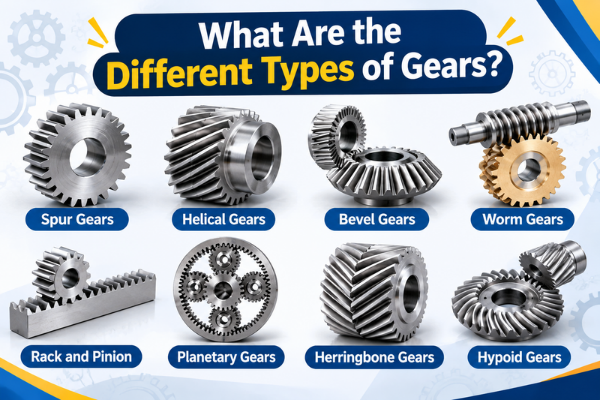
Introduce the major types of gear used in mechanical power transmission. Describe the differences in their shape, their teeth, how they work, their benefits and their disadvantages. Talk about the following common designs, and give examples of gears in use in actual machinery.
Spur Gears
Describe about the straight teeth gears which are positioned parallel to the gear shaft which are also called spur gear and how they transmit the motion between parallel shafts. Talk about their easy, simple build, high rate of transmission, low price of manufacturing and easy maintenance. Provide examples of their use in conveyors, simple mechanical systems, basic mechanical systems and industrial equipment. Also discuss the drawbacks, especially when running at higher speeds, such as increased noise and vibration.
Helical Gears
Explain the helical gears with its description, provide the reasons for its teeth to be at an angle so that it transmits power smoothly and quietly as compared to spur gears. Discuss how they can withstand greater loads, and perform effectively in critical mechanical systems. Explain about axial thrusts they produce and appropriate bearing arrangements. Automotive transmissions, heavy machinery, industrial gearboxes and compressors will all feature applications.
Bevel Gears
Discuss the working principle of bevel gears used for transmitting rotational motion between intersecting shafts, usually at right angles, between the two. Discuss straight bevel and spiral bevel gears, and their differences with respect to tooth design, noise and operating performance. Explain how these gears alter the direction of power transmission and give applications for gears in a vehicle differential, power tools and industrial machinery.
Worm Gears
Explain the working principle of worm gears with the help of a screw like worm and a toothed worm wheel which is used to transmit motion between non-parallel, non-intersecting shafts. Discuss their capability of high speed reduction in a small size and ability to offer large torque multiplication. Explain how they run smoothly and how they can experience friction, heat, and be limited in efficiency. Common applications to include in lifting equipment, conveyors, elevators and any machinery that requires a high speed reduction.
Rack and Pinion Gears
Describe the working of rack and pinion gears to change linear motion to rotation. Explain the operation of a circular pinion and straight toothed rack. Explain how they work, their accuracy of positioning and general applications such as automotive steering systems, industrial automation, CNC machines and mechanical positioning systems.
How Are Different Gear Types Classified?
Describe how shafts and gear types are related to tooth shape, tooth direction and gear classification. Explain about 3 types of shaft arrangement i.e. Parallel shaft, intersecting shaft, non parallel and non intersecting shaft. Recognize that spur, helical, and herringbone gears are examples of parallel-shaft gears, bevel and miter gears are examples of intersecting-shaft gears and worm and crossed helical gears are examples of non-intersecting gears. Also present other special types of mechanical gearing, such as internal, planetary and hypoid gears. Give reasons for the importance of understanding these classifications to engineers to compare different types of gears and choose appropriate gear for required mechanical functions.
Comparing Different Gear Types and Their Applications
Gear Type | Main Advantages | Common Applications |
Spur Gears | Simple design and high efficiency | Conveyors and industrial machinery |
Helical Gears | Smooth and quiet operation | Automotive transmissions and gearboxes |
Bevel Gears | Changes the direction of motion | Vehicle differentials and power tools |
Worm Gears | High speed reduction | Elevators and lifting equipment |
Rack and Pinion | Converts rotary motion into linear movement | Automotive steering and CNC machines |
Planetary Gears | Compact design and high torque | Robotics and automatic transmissions |
Herringbone Gears | Handles heavy loads smoothly | Heavy industrial machinery |
Hypoid Gears | Smooth operation and high torque capacity | Automotive differentials |
Common Applications of Different Gear Types in Industrial Machinery
Talk about the different gears and their role in different industries in the field of power transmission and motion control. Discuss the use of gear drive in an automotive system such as transmission, steering and differential. Shield industrial equipment like conveyors, pumps, compressors and production equipment. Talk about their applications in Robotic and Automation, Aerospace, Medical Devices, Precision Instrumentation and Consumer Electronics. Give real world examples of applications using gear to illustrate the way in which various designs are used to achieve different gear performance requirements including those of speed control, torque transmission, positioning accuracy and reliability. Emphasize the importance of using the appropriate gears to enhance the efficiency and performance of machines.
Choose the Right Gear Type for Your Industrial Application
Using the appropriate gear type is crucial for ensuring reliable performance, smooth operation, and efficient power transmission in industrial applications. Harber MIM is here to assist you if you are unsure which steel gear design, material or manufacturing procedure is best for your project, with precision manufacturing solutions and custom steel gear service. We can consult you about whether you need spur gears, helical gears, bevel gears, worm gears or planetary gears and make recommendations based on your needs. Contact us now to discuss your gear manufacturing requirements, learn about our precision metal injection molding services and discover a dependable solution for your application.
FAQ:
What Is the Difference Between Spur and Helical Gears?
Discuss the similarities and differences in their teeth, sound of their operation, load capacity, transmission of energy to the load and their typical use in industry. Describe the advantage of helical gears in general with regard to their operation at high speed.
Which Gear Type Provides the Highest Speed Reduction?
Explain the possibility of getting high reduction ratios in worm and planetary gear systems, depending on the configuration, gear ratio and design requirements.
Conclusion
Selection of appropriate gears needs to understand the mechanical requirements, shaft arrangement, torque, speed ratio, material properties, operating conditions etc. There are various types of gears and each have their own set of benefits, so it is essential that one should have a good idea of the performance of the gears before choosing a final product. Simple spur gears can be found in a variety of mechanical systems, while more complex mechanisms like planetary and worm gears have specific functions. Choosing the right type of gear and the right manufacturing method can enhance the power transfer, reliability of machines and durability. Precision engineering and manufacturing ability should also be taken into account by manufacturers to produce components for more challenging industrial uses.