en
 de
 jp
 kor
 fra
 spa
 ru
 pt
 it


Jigs vs Fixtures: A In-deepth Engineering Guide
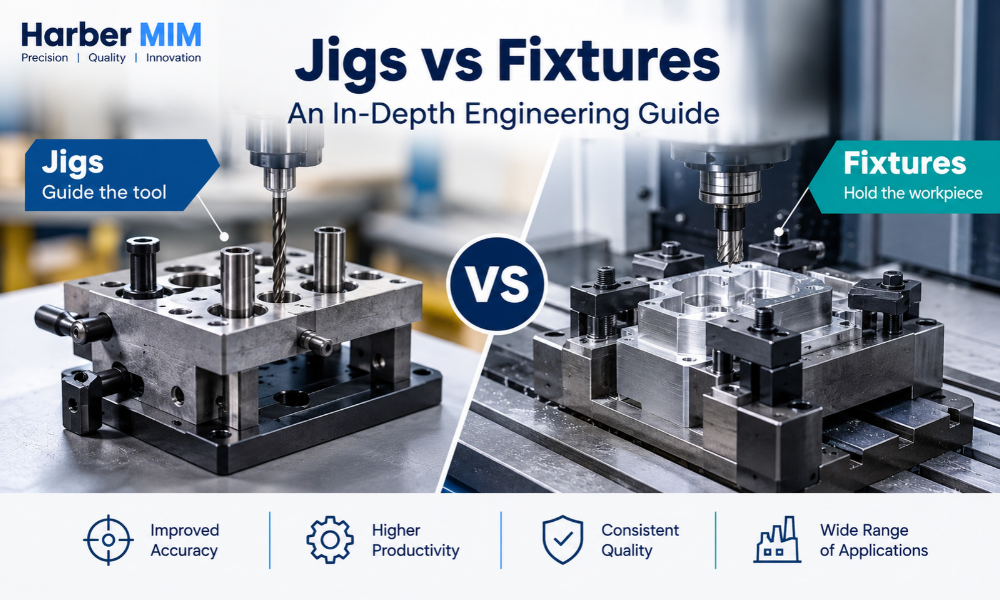
Manufacturing engineers utilize special tools for enhanced accuracy, decrease in set up time, and quality of products. The most frequently used tools are jigs and fixtures that are used to locate work piece in various production processes. While they may sound alike their role is different. This Jigs vs Fixtures guide describes the functions of both tools, the various types, their uses in CNC machining and the key considerations for engineers to choose the right tooling for manufacturing.
What Are Jigs and Fixtures in Manufacturing?
Jigs and Fixtures – a device used to hold a material in place and to give support and security while the material is being manufactured. They aid to keeping the setting consistent, decrease manual measurements and boost repeatability during manufacturing. A jig is usually used for guiding a cutting tool, a fixture is used to position a workpiece without usually providing guiding. Both play important role in machining, being accurate in assembly, inspection and other production processes where accuracy and efficiency are important.
What Is a Jig in Manufacturing?
A jig is a tool used in manufacturing, to hold a piece of work and guide a cutting tool to the proper position. Often contains guide bushings to guide a drill or other tool to a desired location and direction. Jigs are generally used in drilling, reaming and tapping of holes, or for making of features which are to be made repeatedly in the same position. A drill jig can be used, for instance, to increase the accuracy of positioning holes in a number of metal parts and it can decrease marking and measuring tasks that are usually performed by hand.
What Is a Fixture?
A fixture is a device for locating, supporting and clamping a work piece in a manufacturing operation. It is not a normal jig as it is not normally used to guide the cutting tool—rather it is the machine or operator which controls the movement of the tool. Fixtures are extensively used for many different purposes, such as milling, turning, grinding, welding, assembly and inspection. A CNC milling fixture, for instance, is used for fixing a metal part to the table of the CNC milling machine in order to reduce the phenomenon of the part being moved involuntarily and ensure the accuracy of the part during cutting.
Jigs vs Fixtures: Key Differences
Comparison factor | Jigs | Fixtures |
Main purpose | Guides the cutting tool | Locates and holds the workpiece |
Tool guidance | Usually included | Generally not included |
Common applications | Drilling, reaming, tapping | Milling, turning, grinding, welding |
Design priority | Tool alignment and positioning | Stability, rigidity, and workpiece location |
Common construction | Often portable | Often rigid or machine-mounted |
Main benefit | Consistent tool positioning | Consistent workpiece positioning |
Types of Jigs Used in Manufacturing
Based on the shape of work piece, the production requirement and the machining operation, the manufacturers use different designs of jigs. Simple template jigs allow holes (or other features) to be set out. Plate jigs are jigs in which a flat plate is used (usually with guide bushings) to hold and guide the work. Box jigs are used to enclose or support a component and can be used to enable the component to be machined from several sides. Channel jigs can be used for some channel shaped components and leaf jigs have a hinged section to facilitate loading and unloading. Indexing Jigs are used for positioning a work piece in different position or angle for repeated operations. The choice of design will depend on access to the tool, the accuracy needed, the geometry of the part and the number of parts required.
Types of Fixtures and Their Applications
Fixtures are made to suit various manufacturing operations, and each fixture will offer the support and stability required for a specific operation. Milling machine fixtures are used to secure the part being face-milled, slot-milled and contour cut. Turning fixtures are used to hold workpieces that are not suitable for the normal lathe chucks; drilling fixtures are used to hold parts to be operated when forming holes by the lathe tool that is not guided by the fixture. Stable positioning of grinding fixtures in the process of precision finish. Welding fixtures are used to hold the parts in the correct position during welding and assembly fixtures are used to support parts for accurate positioning during assembly, while inspection fixtures are used to hold the parts in repeatable positions for dimensional measurements. The type of fixture required depends on the manufacturing process, the shape of the work piece, cutting forces and degree of accuracy.
How Jigs and Fixtures Work in CNC Machining
CNC (computer numerical control) machining is a technique where the tools are moved based on a program and the workpieces are precisely positioned to ensure that they are manufactured consistently. The requirements are met variously by jigs and fixtures. A jig is a device which physically guides a tool and a fixture is a device which holds the component to be processed on the table of the machine or on an appropriate base. Good tooling will assist in positioning of the work, repeatability of set ups, and minimise production errors. When designing tooling for CNC operations, engineers need to take into account the type of machine used, the clearance required for tools, the clamping force, the ability to remove the chips and the cutting forces.
CNC Machining Fixtures
CNC machining fixtures hold the workpieces in place during automated cutting processes, like milling, drilling, multi-axis machining, and more. Typical features are finding pin locations, clamps, stops and support points which hold the component in place and limit its movement. Cutting forces are highly factors that must be taken into account for a well-designed machining fixture, with the aim of limiting the vibration and deformation of the fixture. It should also be able to give access to the surfaces being machined and it should permit chips and coolant to clear the cutting area. When working with complex parts and numerous operations or setups, this is especially crucial for getting the part positioned correctly.
Fixtures for CNC Machines vs Traditional Jigs
Since the positions of the tools on CNC machines are controlled by programmed coordinates, it is common to apply fixtures to hold and position the workpieces. Although in most cases modern jigs are being used, traditional jigs are still useful in case of a process where physical tool guidance is needed, such as some drilling or tapping processes. The selection will be based on various factors such as the machine, cutting process, component design, and production requirements. CNC fixtures can be used to facilitate repeatable automated processes and appropriate jigs can be used to help guide tools when machine control or the existing process does not offer sufficient guidance.
Benefits of Using Jigs and Fixtures
A good tool design can enhance manufacturing productivity, consistency and quality. Jigs and fixtures help to eliminate the need for repetitive manual measurements and adjustments by holding workpieces in repeatable positions. They can help to reduce setup times, dimensional inconsistencies and scrap and rework. A proper workholding also helps to eliminate unwanted movements during work, which make the working safer and more controlled movements. For mass manufacturing, specific tooling can facilitate repeat operations to be faster and more predictable. The actual benefits, however, are dependent on the design of the tooling, volume of parts to be produced, capability of the machine, and maintenance as well as the accuracy desired for the finished component.
Jigs Manufacturing and Fixture Manufacturing Methods
The first step in the jig/fixture manufacturing is to review the engineering drawings, CAD drawings, workpiece size, tolerance and production requirements. Engineers then choose appropriate materials and standard components such as clamps, locating pins, guide bushings and support components. Depending on the design, CNC machining, drilling, milling, grinding or metal fabrication may be involved in the production. Following the manufacturing, the individual components are then assembled and checked to ensure they are the correct size, shape and fit for function. The completed tooling will be tested under proper operating conditions prior to full production in order to ensure proper performance of the tooling. The type of tooling that is used is reliant upon the complexity of the design, the desired accuracy, the volume of parts to be manufactured, and budget.
How to Choose Between a Jig and a Fixture
The first step in selecting proper tooling is to be able to pick out the manufacturing operation and the question of whether or not the cutting tool requires physical steering. The next step should then be taken by the engineers where they analyze the workpiece geometry, locating requirements, workpiece clamping, dimensional tolerances, production quantity and the expected setting time. A jig with guide bushings might be useful for a drilling process that calls for a series of holes all in the same location to be drilled. A CNC milling operation, on the other hand, needs a very firm fixture to retain the part on its place and the programmed cutting tool moves around the part. Consider also tooling, maintenance, compatibility to machine and machine life. The most suitable one is the one that is able to provide the process with what it needs and does not do more than is necessary or create extra cost.
Applications of Jigs and Fixtures Across Industries
Specialized tooling is essential in manufacturing industries to ensure a uniform production process and to make uniform components. Jigs and fixtures are used in the automotive industry for manufacturing engine parts, brackets, body parts and assemblies. Precision Tooling is utilized in the manufacture of structural parts and complex machined components by Aerospace Manufacturers which are required to be produced with tight tolerances. Medical device manufacturing can sometimes involve special purpose tooling to assure accurate component machining and repeatable inspection. Positioning and assembly tools are used to help position small components during electronics production. Gears, shafts, housings and mechanical assemblies are also special tooling that industrial machinery manufacturers depend on. In all these areas the design has to correspond to the part's required production volume, manufacturing process quality requirement, and part.
Common Mistakes to Avoid When Selecting Jigs and Fixtures
Wrong tooling can make the production more costly and result in poor quality parts. A common error is to pick a jig for a physical tool guidance application where it is not needed, or to pick a fixture where physical tool guidance is required but the fixture is not rigid enough for the application. Too much clamping pressure will cause a workpiece to become distorted and too little will result in the workpiece moving when it is being cut. Avoiding paying attention to tool clearance, chip removal, coolant access, and operator safety are also factors that should not be overlooked for the engineer. A common issue is that production volume and maintenance needs are not taken into account when designing high cost custom tooling. These issues can be avoided and manufacturing performance enhanced for the long term with a careful design review, a proper choice of material and some practical testing.
Why Choose Harber MIM for Precision Manufacturing Solutions?
To ensure accuracy, consistency, and efficiency in manufacturing operations, there is a need to understand the differences between jigs and fixtures. Harber MIM provides precision manufacturing experience to assist the engineers and manufacturers in creating dependable metal components for various industrial applications. Parts made with metal injection molding can be the difference between an improved production process and a better understanding of the tools needed, especially when choosing the right manufacturing partner to get high-quality parts for your needs. Connect with Us Today about your engineering project, discuss how we can help you manufacture, and determine the best solutions to your manufacturing needs.
FAQ:
What is the main difference between a jig and a fixture?
A jig is usually used to hold and guide the cutting tool and a fixture is used to locate, support and clamp the work piece but not to guide the cutting tool.
What are jigs used for in manufacturing?
Jigs are generally employed for drilling, reaming and tapping, where it is necessary to position the tool in the same location repeatedly. Guide bushings are used to guide the cutting tool to the proper position.
Conclusion
Knowing the difference between Jigs vs Fixtures in terms of their functions will assist the engineer in making tooling decisions. Jigs are used primarily to guide cutting tools and fixtures primarily are used to locate and hold a work piece during manufacturing. Excellent repeatability, consistent quality and a reduction of unnecessary set up work for both can be obtained when correctly designed for the application. The final selection should take into account the machining operation, geometry of the workpiece, tolerance, quantity of the products and budget. Manufacturers can consider these factors to provide reliable tooling solutions which will enable efficient production and accurate components.