en
 de
 jp
 kor
 fra
 spa
 ru
 pt
 it

MIM Industries: Everything to Know (6 Sectors, 2026)
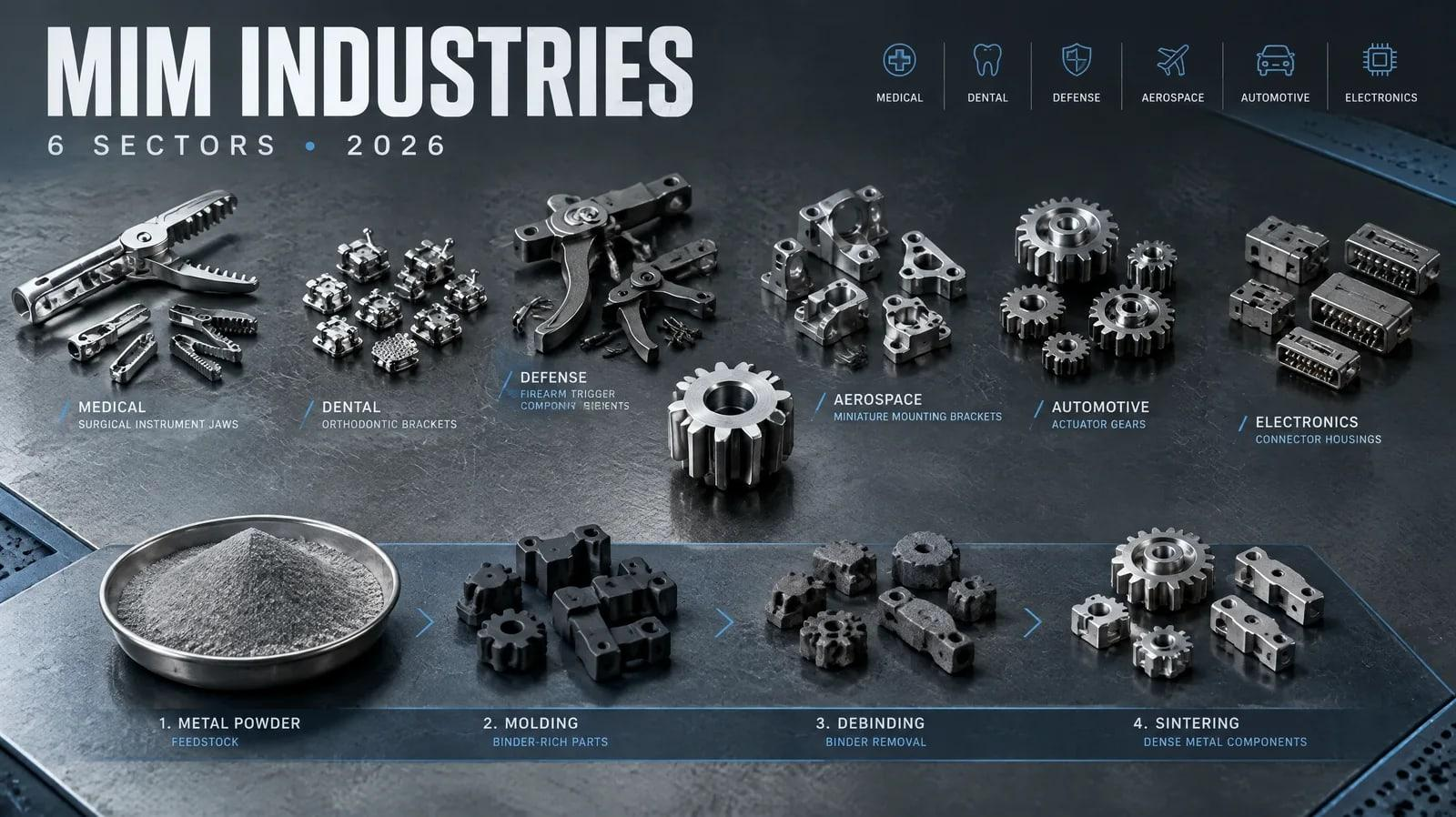
MIM industries are those industries that make use of metal injection molding for mass production. Medical and dental, defence and firearms, aerospace, automotive, and electronics are included. In Metal Injection Molding, fine metal powder gets mixed with a binder, injection molded, debound and finally sintered into dense near net shape parts.
You are probably aware that MIM takes metal powder and turns it into intricate tight-tolerance parts. In all likelihood, you’ve seen the typical automotive, medical, aerospace, etc.
Most guides don’t talk about which industries are a good MIM fit, what the 2026 numbers say, and when MIM isn’t right. This guide links each industry to the parts and materials it normally uses, reconciles the differing numbers we find in the marketplace, and ends with a MIM manufacturer selection checklist.
Principal learning points.
● Metal injection molding (MIM) is a powder metallurgy manufacturing process in which fine metal powder is mixed with a binder, injected like plastic, binder removal and final sintering of the part.
● Manufacturing industries include the medical, dental, defense, and firearms, aerospace, automotive, electronics, and consumer or recreation products.
● MIM material includes metal alloys, stainless steel, ceramic, and plastic that are high-functioning heat resistance.
● MIM is suitable for high-volume orders of complex small metal parts. Tooling cost makes it a bad match for large parts or low volumes.
● Analysts believe that the metal injection molding (MIM) market in 2026 could reach from round $4.6 billion to $7.2 billion. This is because each firm defines the market differently.
● Before requesting quotes from MIM manufacturers, buyers should check their tooling, secondary operations, certifications and volume capability.
What Are MIM Industries and Metal Injection Molding?
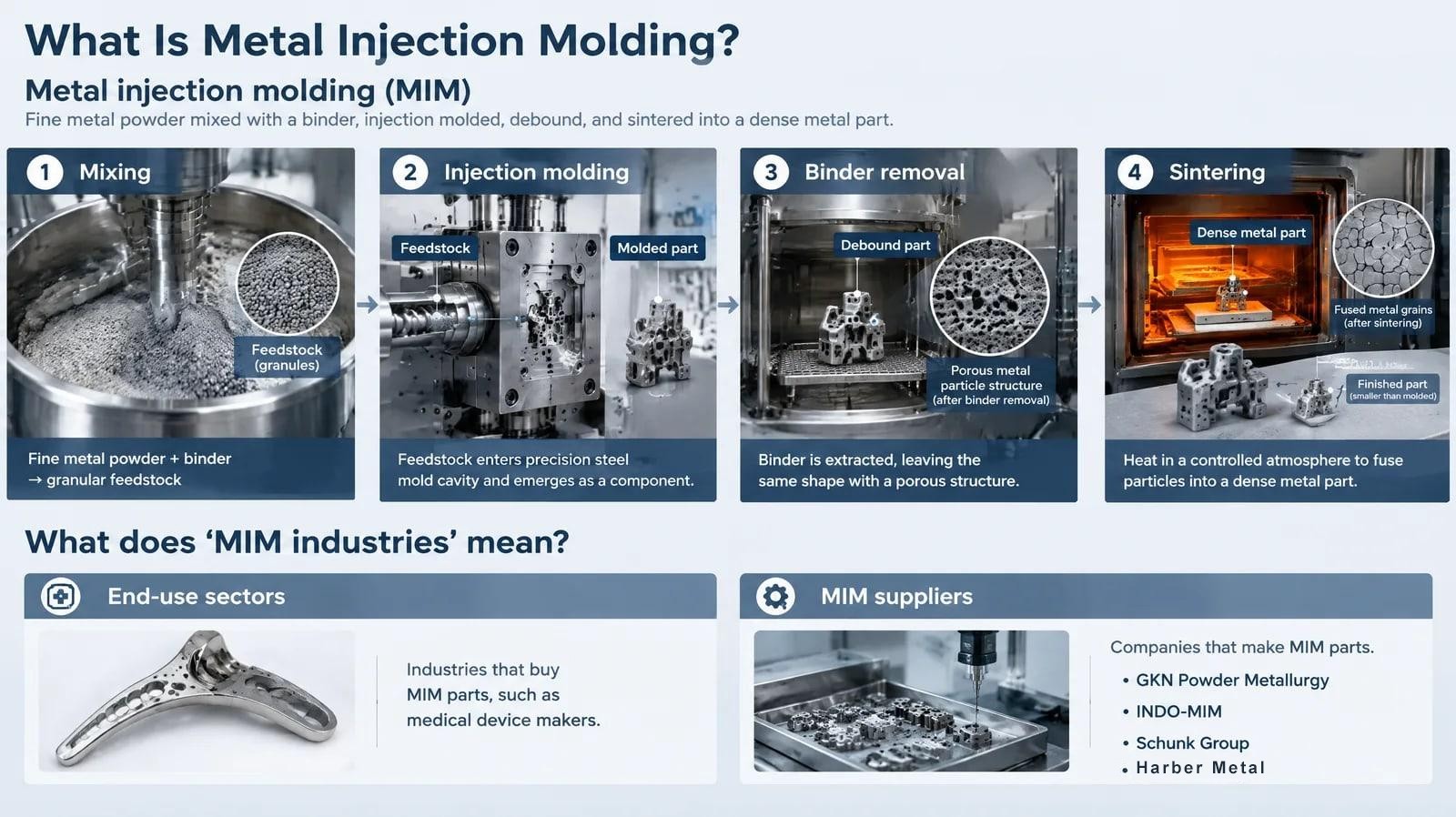
Metal injection molding (MIM) is a process that produces parts from metal powders similar to plastic injection molding, but it requires significantly higher pressures to deliver the required performance. Think of plastic injection molding, but replace the plastic with the powder of metal, and by plastic-like binder. During the molding operation, removal of the binder takes place and heating of the part takes place so that the metal grains fuse up to a point to form a dense solid product.
The term “MIM industries” is used in two ways This refers to different end-use markets that purchase MIM parts such as for medical devices. It can also refer to the MIM companies which produce them such as GKN Powder Metallurgy, INDO-MIM and Schunk Group. Both definitions are relevant to a buyer. Therefore, the sectors are covered first and suppliers in the buyer's checklist below.
Two associations monitor the field: the Metal Injection Molding Association, otherwise known as MIMA, and the Metal Powder Industries Federation, otherwise known as MPIF. The MIM parts are worth viewing if you want to see work examples.
Who Are The Users Of MIM Metal Injection Molding?
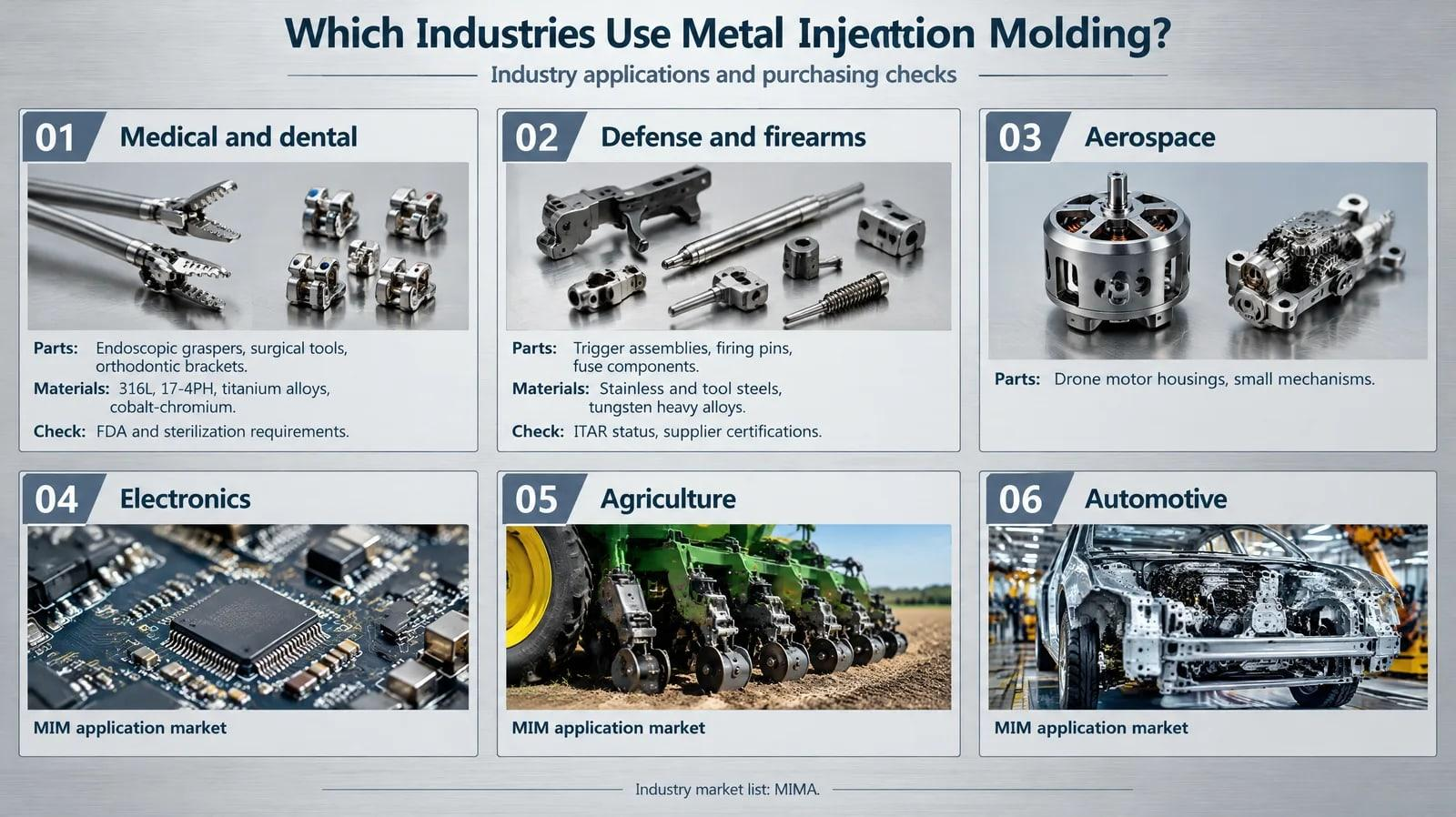
According to MIMA (Source: MIMA), metal injection molding is used in industries like aerospace and defense medical and dental electronics and agriculture automotive and others. The screening tool is involved in the table below. It matches each sector with illustration components, general metals, and important checks prior to purchase.
Industry | Example MIM parts | Typical materials | What to check | Evidence behind the row |
Medical and dental | Endoscopic graspers, surgical tools, orthodontic brackets | 316L, 17-4PH, titanium alloys, cobalt-chromium | FDA and sterilization requirements | Peer-reviewed review, Xometry |
Defense and firearms | Trigger assemblies, firing pins, fuse components | Stainless and tool steels, tungsten heavy alloys | ITAR status, supplier certifications | Jiga, MIMA, GKN, Schunk |
Aerospace | Drone motor housings, small mechanisms | Stainless steels; high-entropy alloys (early stage) | AS9100 quality system | Jiga, Wevolver |
Automotive | Small mechanism parts | Steels (confirm grade with supplier) | Volume and per-part cost targets | MIMA market list |
Electronics | Connectors, heat sinks | Stainless steel, copper | Thermal and electrical needs | Jiga |
Agriculture, consumer, recreation | Varies by product | Steels | Cost per part at volume | MIMA market list |
The sources we have gathered for this guide have one pattern. Out of all the medical rows, only one is supported by a peer-reviewed paper. The others rely on trade bodies and vendor pages. Regard "What to check" as a question list for your supplier rather than a verified requirement.
How MIM is Used in Manufacturing Medical and Dental Article
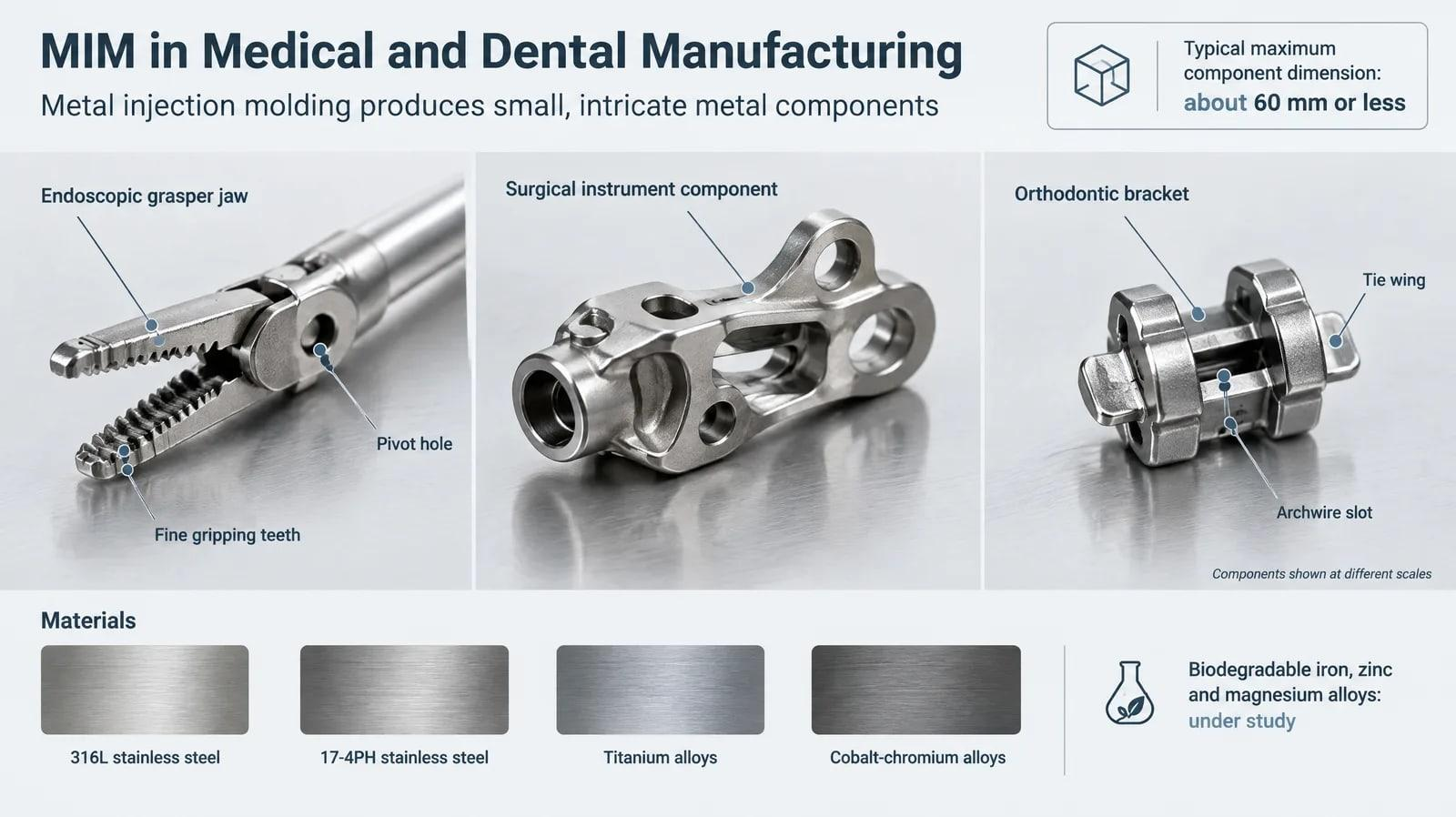
MIM fabricates tiny, complex medical components, including endoscopic graspers, surgical instruments, and orthodontic brackets. According to a peer-reviewed review, MIM has become an increasingly important technology for small, intricate components with a typical maximum dimension of about 60 mm or less, including medical devices, implants, and surgical tools. Metal injection molding medical market is showing that much demand.
The clinical MIM materials include stainless-steel, titanium alloys, cobalt-chromium alloys; commercialized biodegradable iron, zinc, and magnesium alloys. In practice, 316L and 17-4PH are the work-horse stainless. Wevolver also talks about Nitinol for dental and medical applications (Wevolver, 2023).
Here is a useful caveat. As research is ongoing on the biodegradable alloys, they belong on a research watchlist, not a production drawing. Stainless and titanium alloys have stood the test.
Rules also require caution. Xometry states that MIM can meet FDA and sterilisation requirements (Source: Xometry, 2026) This does not mean that it automatically makes a device compliant. The finished device and the manufacturer of the product are regulated by the U.S. Food and Drug Administration (FDA), therefore ask any supplier about the quality system, which is typically the medical standard ISO 13485, with which they operate and about how the selected alloy will withstand multiple sterilizations.
How is Metal Injection Molding Used in Defense, Firearms, Aerospace?
MIM is used for small complex mechanical parts like those found in defense, aerospace, and others. According to Jiga (2025), Jiga names drone motors, mechanical fuse components, and firearm trigger assemblies. MIMA, GKN Powder Metallurgy, and Schunk also cite defense and aerospace as MIM markets, with firing pins appearing in the same part families.
Consider this list as a complete set. Everything is small, made of geometry and manufactured in bulk. The part’s profile that the MIM screening test later in this guide rewards explains why defence injection moulding services tend to cluster around these parts.
Caution is advised with public info. Documentation for defense components and standards is vague, with no of the pages reviewed detailing qualification requirements. Before you commit, get three things in writing from a supplier.
● ITAR status is whether the supplier is set up to handle defense-controlled parts under the International Traffic in Arms Regulations.
● AS9100 certification is the most common quality standard among aerospace buyers.
● Keeping a record of powder lots and furnace runs of materials.
Wevolver says that high-entropy alloys are a fledgling option for aerospace, defense, and automotive use (Source: Wevolver, 2023). For the time being, consider them trials.
How MIM process works?
The process of MIM includes mixing the powder with a binder to give feedstock. The feedstock is injected to give “green” part. Following which, the green part is debound. Finally, the last stage is sintering in a furnace with controlled atmosphere. Designing for each step requires knowing each step.
1. To create means of feeding, fine metal powder is blended with a binder. According to MPIF MIM powders are generally finer than 20 micrometers. The fine consistency of this powder is the reason raw material is costlier than bar stock.
2. Molding is a process of injecting Feedstock into a mold like plastic. The outcome is a tender green component that exceeds the final size.
3. The binder is removed using either solvents, heat or a combination of both, leaving behind a porous brown part.
4. The powdered particles of the component are heated for bonding. Steels are typically sintered at about 1,200–1,400°C (Jiga, 2025).
The impact of design is easily missed. During sintering, parts shrink; therefore, molds are cut oversized, and tolerance depends on how evenly a part shrinks.
Materials typically used for producing medical instruments and implants include 316L and 17-4PH stainless steels. Another commonly used material is 420 stainless steel. Available materials are titanium Ti-6Al-4V, cobalt-chromium, copper, and tungsten heavy alloys.
One cycle-time example that Jiga gives is that a part needs 20–40 minutes on a multiaxis machine. But, it only needs 2–4 minutes in the mold. After that, it goes through debinding and sintering (Jiga, 2025). This means a mold step about 10 times faster (20 ÷ 2 and 40 ÷ 4 is equal to both 10). By neglecting debinding and sintering, this comparison only depicts the molding step, not the overall lead time. This is a single case that illustrates a point and not a general rule.
What Is the Size of the MIM Market in 2026?
According to various research firms, the 2026 MIM market is expected to be in the range of $4.6 billion to $7.2 billion. Firms differ on whether they count only finished parts, feedstock, or related services, causing the gap in scope. The data displays five published figures next to each other.
Source | 2026 estimate | Growth outlook |
$4.6B (up from $4.2B in 2025) | 7.5% CAGR, 2026–2035, to $8.8B | |
$5.14B (up from $4.71B in 2025) | 9.2% CAGR | |
Research and Markets, 2026 (second report) | $6.35B (up from $5.79B in 2025) | Not stated here |
$6.68B | To $14.05B by 2034 | |
$7.2B (up from $6.5B in 2025) | 9.5% CAGR, to $13.5B by 2033 |
Calculating these five figures reveals just how large the spread really is. The top estimate is about 57 percent higher than the bottom one ($7.2B ÷ $4.6B) a gap of $2.6 billion. Roughly $6.0 billion is the simple average of the five. Research and Markets show a $1.2 billion gap–with just one publisher–between its own two reports.
Use a range with named sources, e.g., “about $4.6 billion to $7.2 billion in 2026,” not a single number. All five sources agree that growth is the way forward.
In terms of regional context, Asia Pacific accounted for the largest volume share of the world MIM parts market at 52.1% in 2025. Source: GlobeNewswire press release via Yahoo Finance (February 2026). As per the Wikipedia, the market expanded from US 9 million in 1986 to more than US1.5 billon in 2015 (Wikipedia). This is an old data and not much useful except as background.
How do you select a MIM company or service provider?
When selecting a MIM manufacturer, check for five things before asking for quotes: tooling, secondary operations, certifications, volume capability and pilot runs. The sources on this are thin, so treat this as practical guidance rather sourced fact.
● Who designs and builds the molds for in-house tooling? The largest up-front cost involved in the molding process is the mold itself; suppliers with owned molds can adjust for shrinkage promptly.
● Some parts require heat-treating, plating, machining, and passivation as secondary operations. According to INDO-MIM, they have in-house heat treatment and plating. MIM parts which are heat treatable and plateable – but confirm whether your supplier does the finishing in-house.
● Align Certifications to Your Industry ISO 13485 for Medical AS9100 for Aerospace ITAR for Defense. Request certificates, not claims.
● Volume range: Find the sweet-spot of supplier. A store that was created for a million minute components may not want a few thousand.
● Before authorizing full production, request first-article parts and a dimensional report for a sample or pilot run.
MIM uses injection molding presses as well as debinding and sintering furnaces, with suppliers typically adding automation for part handling and inspection. The pages we reviewed didn’t cover MIM machine selection in depth. Inquire how suppliers check their parts, which will tell you more than an equipment list.
If you are holding MIM in contrast to other methods, you can also look at industrial tool parts to see how similar metal pieces are created.
When is a MIM not a good option?
MIM is an unsuitable selection for large components, little volumes and thick sections. MIM has equipment limitations which affect its efficacy per shot, which is only 100 grams or less per shot(Source). The review, which is peer-inspected, gives us the framework. The sweet spot for maxima is about 60 mm or less.
A description of a patent (source: patent description, undated) gives two older rules of thumb. Due to high mold prices, MIM isn't economic at low volumes (when larger volumes are cheaper). The maximum size for conventional MIM is limited to about 12 mm in the thickest section, since fine powders are costly and the time taken for binder removal is lengthy. Look at them both as broad principles rather than fixed thresholds.
The cost in comparison to plastic is another limit. According to Xometry, MIM is stronger and more damaging while plastic injection molding is the cheaper option for less complex parts (Source: Xometry, 2026). If you can get the strength you need from a polymer, MIM is overpriced.
Process | How it shapes metal | Best fit | Weak spot |
MIM | Molds metal powder and binder, then sinters | Small, complex parts in high volume | Large parts, low volume, thick sections |
CNC machining | Cuts material from a solid block | Prototypes, low volume, tight features | Slow and wasteful on complex parts at scale |
Forging | Shapes solid metal through compressive force | Strong, simple-to-moderate shapes | Limited geometry detail |
Die casting | Injects molten metal into a die | Larger parts at volume | Fewer alloy choices than MIM |
The CNC and forging description conform to Unionfab’s FAQ (Source: Unionfab, 2024). The row over die casting is common knowledge in the industry.
Here’s a short screening test created using the above limits. Is it true that the component has a diameter of at least 60 mm or less? Will you construct one thousand or more units? Are there complicated shapes which will result in many setups for machining? Three “yes” answers make the part a strong candidate. If you receive one or two “yes” responses, price out CNC or casting with MIM.
Summary.
MIM suits best when a part is small, complex, and required in volume, which is why medical, defence, aerospace, auto, and electronics lead. Run your part by the three-question screen above before you request quotes. Upon passing the part print, ask each supplier tooling, secondary operations, certifications and a pilot run. If it fails, price CNC machining or casting alongside that one. When citing market size, mention the range of 2026, not a figure.