en
 de
 jp
 kor
 fra
 spa
 ru
 pt
 it

CNC Deburring Explained: Methods, Tools and Specs (2026)
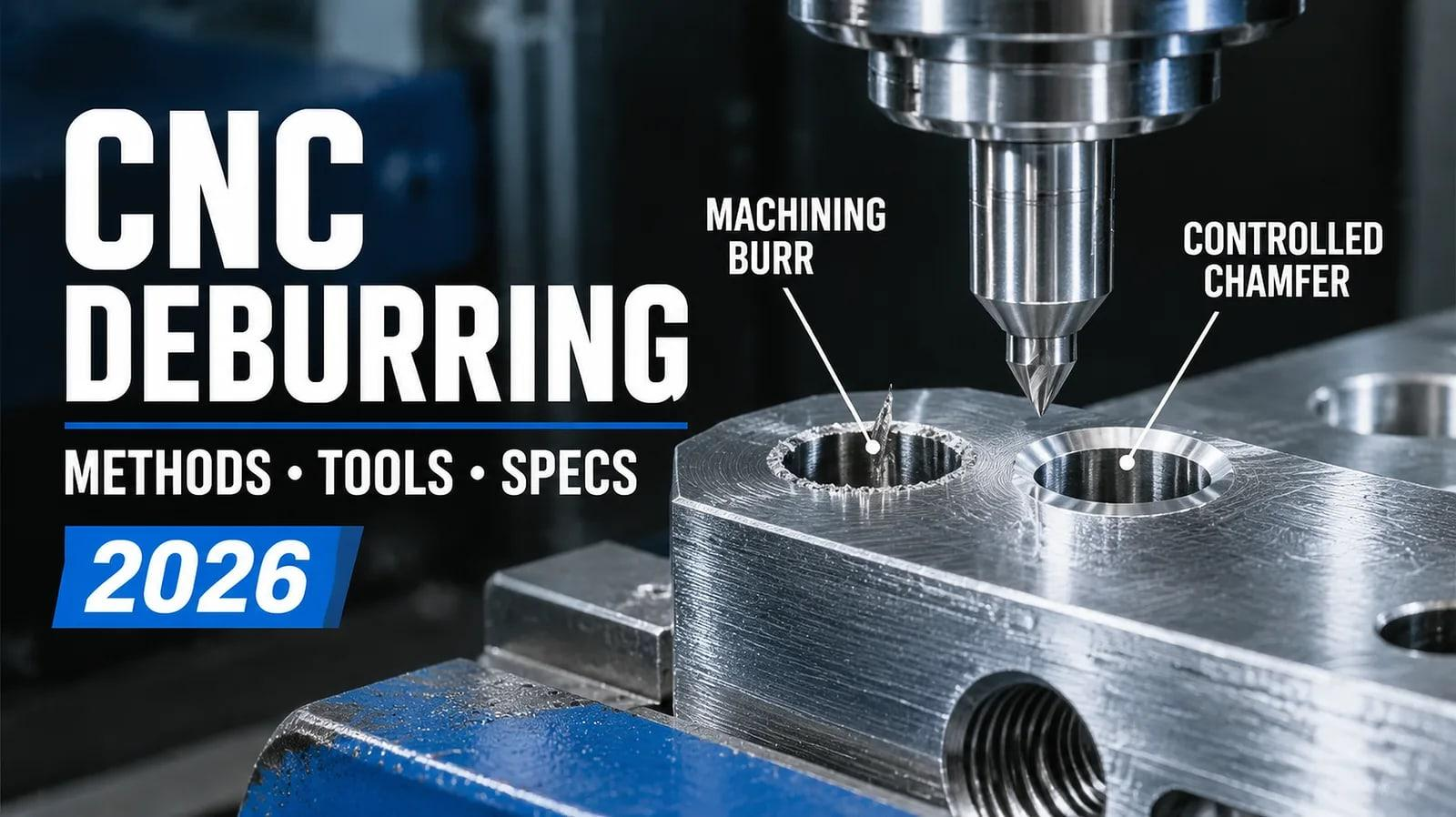
CNC deburring refers to a CNC process that strips protrusions from the parts produced through CNC machining. It is achieved within the equipment itself using chamfer mills, back-chamfer tools or brushes, or through other separate processes such as thermal, electrochemical or vibratory finishing, ensuring the part is safe to handle, precise and ready to assemble.
Even though a part looks finished it can still have sharp edges that prevent him from being assembled or cause it to fail inspection. Most guides never get beyond the tools’ list. They do not help you figure out how to pick a method by burr location or write a drawing note your supplier reads the same way you do. This 2025 Guide is for Both.
Main Points
● CNC deburring refers to an important post-processing step that involves the removal of burrs from manufactured parts, so they can be safe and ready for assembling.
● The location of the burr should dictate the method chosen to remove it, accessible external edges lend themselves to in-machine tools. However, cross-holes and internal intersections will often necessitate the use of a brush, thermal or electrochemical technique.
● Deburring while manufacturing uses tools like chamfer mills or ball end mills or back-chamfer tools. It works best when the edge is accessible and measurable.
● A burr-free drawing note is interpreted in many ways by different manufacturers/ suppliers whereas ISO 13715-based part with the maximum allowed burr size and required edge break is a measurable target for the manufacturer/ supplier.
● The main in-machine failure modes to monitor are brush wear, coolant contamination and cutter gouging.
What is CNC Deburring and what Does Deburred Mean?
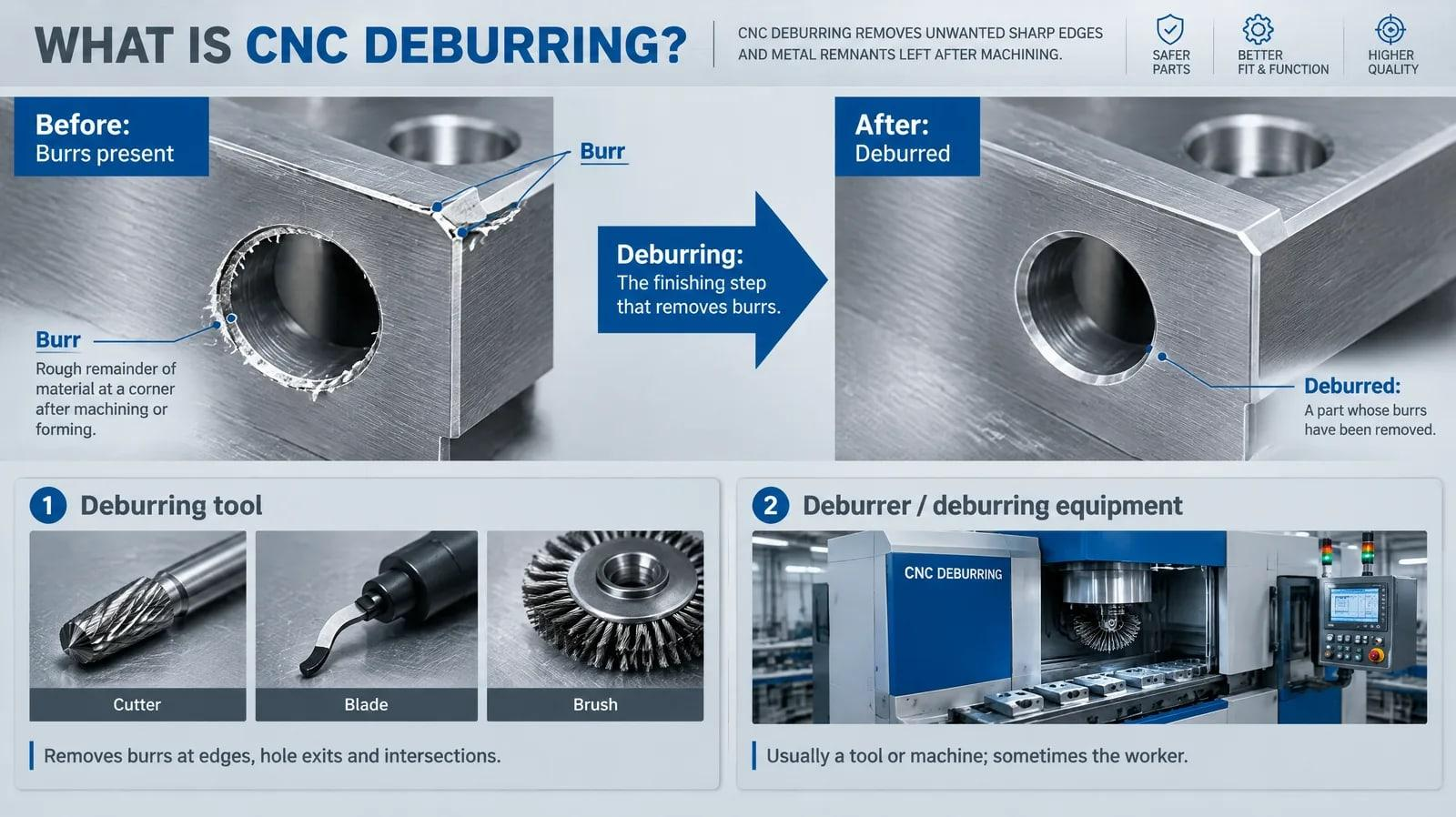
Deburring refers to the finishing step that removes offcut materials (also called burrs). A deburred part is one where burrs have already been removed. ISO 13715:1994 defines a burr as a “rough remainder of material at a corner, left after either machining or a forming process” of the 1994 edition, which standards, by ISO 13715:2017. It is used for anything from CNC machining parts to sheet metal.
The search terms are overlapping , here is the difference.
● Smoother Edge Creation
● Deburred, that is the state of the part afterwards.
● A deburring tool removes burrs and is used on edges, hole exits and intersections. It can either be a cutter, blade or brush.
● A deburrer is generally a tool or machine, although some shops use the word for the worker so look for context.
● A different goal: Edge rounding Deburring will remove unwanted peaks. Edge break creates a defined chamfer or radius.
This last point matter. A deburred part is not automatically edge-broken to spec. Thus, a drawing that requests a 0.2 mm radius must clearly state this.
Some burrs are easier to remove than others. It is hardest to reach those burrs that are at the internal bore edges on the back sides of the workpieces. Further, thermal-cut burrs are harder than machining burrs.
Selecting a Deburring Method per Burr Location: Different Solutions
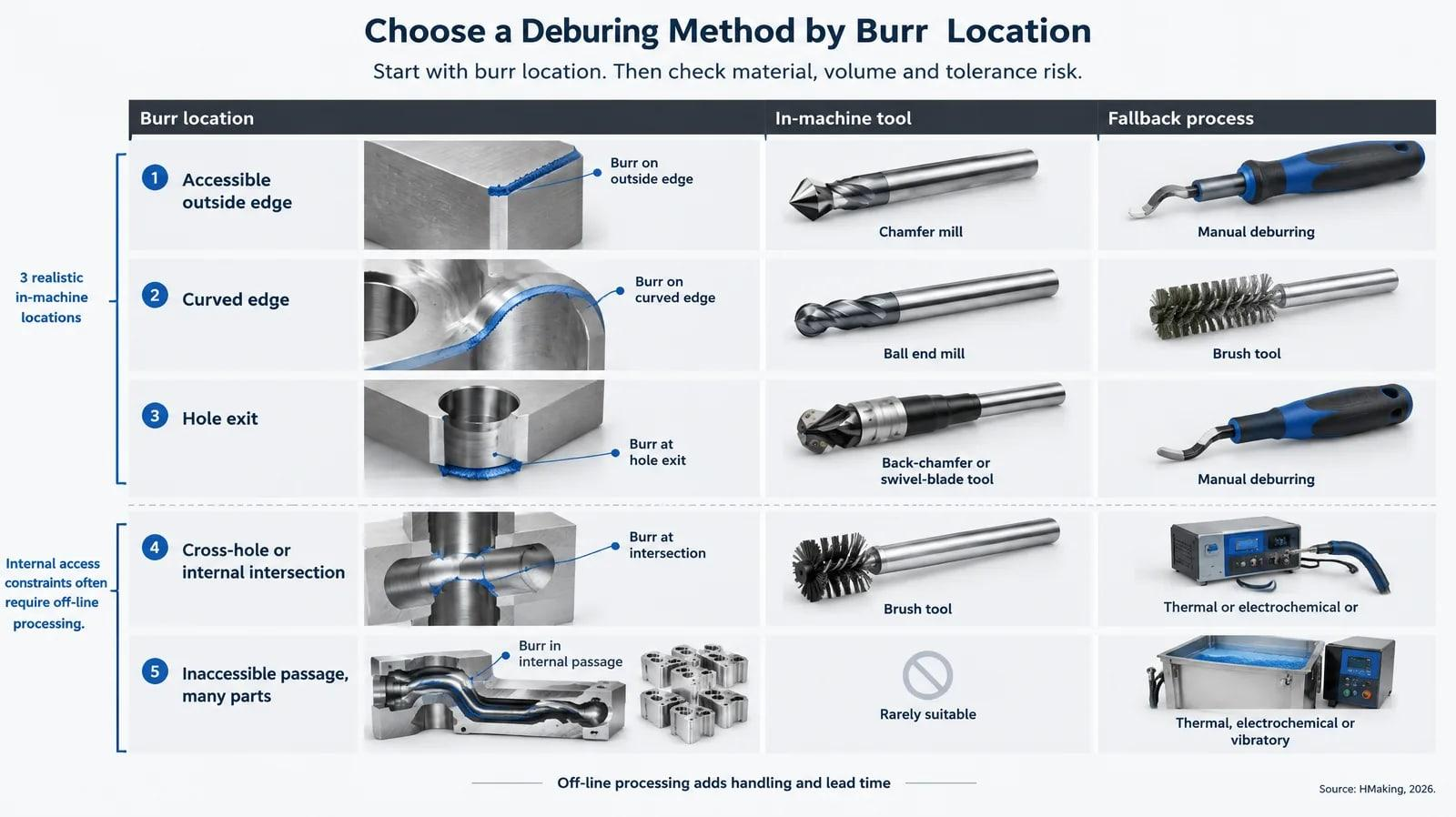
Prioritize selecting method by burr location then check against material, volume and tolerance risk. (HMaking, 2026) The matrix below follows the same logic.
Burr location | In-machine tool | Fallback process |
Accessible outside edge | Chamfer mill | Manual deburring |
Curved edge | Ball end mill | Brush tool |
Hole exit | Back-chamfer or swivel-blade tool | Manual deburring |
Cross-hole or internal intersection | Brush tool | Thermal or electrochemical |
Inaccessible passage, many parts | Rarely suitable | Thermal, electrochemical or vibratory |
Only three of these five places are feasible in-machine works. The remaining two push you to alter your trajectory that requires handling and lead. It is good to know this before quoting a CNC milling part with intersecting holes.
The process of thermal deburring uses an explosive gas mixture to burn off hard-to-reach burrs on multiple surfaces at the same time. Electrochemical deburring refers to using an electrolyte to dissolve burrs between a tool and part
For a swivel blade tool, the program Normally approaches in Rapid Feed (G00), followed by controlled Feeding (G01) on the edge. Use the stronger side of the blade for cutting, not the sharp-end tip.
When Each Equipment Deburring Is the Wrong Choice.
Deburring within the machine is difficult in narrow areas with lots of burrs. Be on the lookout for three types of failure.
● Brush wear means the brush has to be advanced regularly to compensate.
● Brush abrasion is carried away by the coolant.
● Gouging refers to cuts that are made with too much depth. A shiny edge may also be sharp.
How do you budget, inspect and specify deburred edges?
ISO 13715, a drawing-callout system, is intended to specify the permissible condition of undefined edges and is not a general burr-size limit (Source: Clinalu, 2026). According to DIN ISO 13715, when an edge deviates more than 0.05 millimeters from the ideal shape, it is classified as burr-like. That would be 0.002 inch, but take this to be a definition, not a pass/fail line.
“Burr-free” is not a defined term, therefore two suppliers can deliver different edges and both claim to meet the requirement. Better would be callout lists.
1. Leading edge of cutter body.
2. Necessary edge mending (chamfering or rouding).
3. What edges it covers.
4. Direction of Burr, if applicable.
5. Intake method of testing.
To ensure quality control, it is very important to prove the setup on a representative part and measuring the feature before and after, so over-cutting does not eat your tolerance. Check it by touch or microscope, and modify the CNC program if burrs persist.
Another option is cost. Many fabrication shops incur 30 to 35% of their manual labor costs on finishing (Timesavers, c. 2023). Assuming an annual budget of $200,000 for manual labor, that is around $60,000 to $70,000. Deburring is also moving toward CNC, robotic and abrasive-based automation rather than manual work. Including a little chamfer in the tool area that consistently leaves a burr may influence that work at the design stage.
Common Questions Asked.
What do you use to smooth metal?
You can opt for a manual tool, in-machine cutter, or off-line process. Various tools that can be used to handle the burrs of the parts include hand knives and files for prototypes or chamfering mills and brushes inside the CNC. For hard-to-reach or high-volume burrs, thermal, electrochemical, or vibratory finishing can be used.
Is a file a viable tool for deburring?
Certainly A file removes burrs from the edges that you can get at. They are often used to finish one-off or low volume parts. It’s a slow process, reliant on operator skill, which can remove excess material or leave uneven edges, making it a poor choice for tight edge specifications.
What is the recommended deburring approach for prototype designs?
The most flexible process is manual deburring (Wikipedia, 2019) which is good for prototypes and low volume. For high volume applications, in-machine or automated methods are favored as labour costs and part-to-part consistency matter more.
Conclusion.
Select a method that matches the burr site, and then create the edge requirement to minimize misreading. On your next order, remove "burr-free" and replace with a callout that states maximum burr height, edge break, affected edges and inspection method. Next, measure the first-off parts before and after deburring to ensure the process maintains your tolerances.